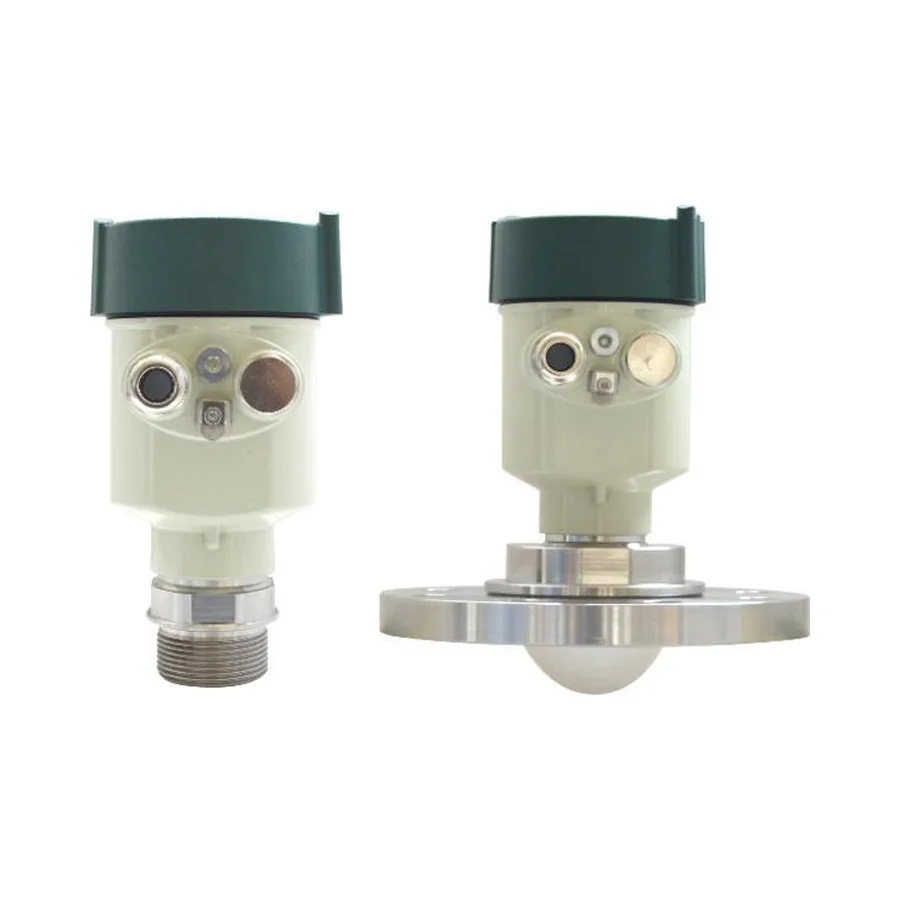
RLM-120 radar level sensor for poultry feed silos
SKU: RLM-120
Measures the feed level in a silo from the roof, without touching the feed.
- Frequency
- 76 to 81 GHz
- Range
- 15 m / 35 m / 85 m / 120 m
- Accuracy
- ±1 mm
Radar feed silo level sensor that measures from the roof
The RLM-120 is a radar level sensor for feed silos. It is fitted to the roof of the silo and points down at the feed. The sensor sends a radar signal in the 76 to 81 GHz band, the signal reflects from the surface of the feed, and the sensor measures the distance to that surface to ±1 mm. Once it knows the height of the silo, it gives the level of the feed and the fill of the silo as a percentage.
Nothing touches the feed. There is no cable hanging in the silo for the feed to drag on, no paddle to jam and no part that wears as pellets slide past it. The signal leaves the sensor through a lens antenna as a narrow beam, 3° or 8° wide. A narrow beam matters in a feed silo, which is tall and slim: the beam travels down the middle of the silo and reaches the feed without spreading onto the walls.
The feed silo that runs empty on a weekend
Every grower knows the sound of a feed line running with nothing in it. Silos are checked by knocking on the wall, by looking through a sight glass or by climbing the ladder, and all three are easy to skip on a busy day. The level is then a guess built on the date of the last delivery, and the guess fails in the weeks when the birds eat faster than expected. The silo runs out on a Saturday night, the feed mill is closed, and the flock stands without feed until a truck can be found.
An empty silo costs more than the hours without feed. Broilers lose growing time, layers can answer with fewer eggs in the following days, and a breeder flock on controlled feeding becomes restless and hard to manage. When the feed returns the birds crowd the pans, and scratches and smothering are a risk.
With a level reading on each silo the order is placed from a figure. The grower chooses the level at which to call the mill, with the delivery time of the mill in mind, and sees the silo approaching that level days ahead. Nobody climbs a ladder in the rain to find out.
Feed deliveries, feed changes and bridging in the silo
The level record does more than warn of an empty silo. After a delivery the level steps up, and the step shows which silo the driver filled and when. On a farm with two silos per house, or a row of similar silos along the yard, feed blown into the wrong silo is found the same day, before starter and finisher have been mixed.
Feed changes are easier to time. A broiler house moves from starter to grower to finisher, and the last ration before catching often has to be fed for a set number of days. Each change goes cleanly only when the silo is close to empty as the next ration arrives. Watching the level fall toward the changeover day lets the grower order the right load for the right morning and avoid blowing new feed on top of several days of the old one.
The record also helps with feed that stops flowing. Damp weather, fine meal or a long standing time can make feed bridge across the cone or hang on the walls. From the ground a bridged silo and an empty silo look alike: the auger runs and nothing arrives. A level that stands still while the feed lines have been calling for feed tells the two apart at a glance, and the grower knows to reach for the mallet before phoning the mill.
How the level reading relates to the feed in the silo
The sensor measures a height. Feed does not lie flat: a delivery leaves a peak under the fill pipe, and drawing feed from the bottom pulls a funnel into the surface. The radar reads the point of the surface under its beam, so the reading moves a little with the shape of the surface as well as with the amount of feed.
The silo also changes shape on the way down. A metre of level in the straight part of the silo holds far more feed than a metre in the cone at the bottom. Once the level reaches the cone the silo empties quickly, so it is sensible to set the reorder level above the cone.
For daily work the fill percentage is the handiest figure. It reads the same way on a tall silo and on a short one, and a row of silos can be compared in one look.
Mounting position for a radar level sensor on the feed silo roof
Position decides how clean the echo is. The sensor goes on the roof of the silo, pointing down, at least 200 mm from the wall. Many farm silos are built from corrugated or bolted sheets, and seams and corrugations reflect radar. On such a silo, mount the sensor as far from the wall as the roof allows. Where a reflection from the wall still interferes, an angle adjustment device lets the antenna be turned away from it.
Keep the sensor away from the fill inlet. Feed falling through the beam during a delivery disturbs the measurement, and the peak of the pile forms under the inlet.
Two mountings are available. The threaded versions are G1-1/2 with a 34 mm antenna and G3-1/2 with a 70 mm antenna, and there are flange versions for a silo with a suitable opening in the roof. The sensor is rated IP67 and runs on 12-24 VDC.
- Bend the cable downward before it enters the housing, so that rain runs off the cable and away from the entry.
- Tighten the cable gland, and close any unused entry with a blind plug.
- Do the roof work when the silo is being serviced or stands empty between flocks, with the fall protection the silo requires.
Setting up the sensor for feed from a phone
The sensor is configured over Bluetooth from a mobile phone, so the settings are made on a phone screen once the sensor is in place. It also has a display and buttons of its own. Four settings matter on a feed silo.
The damping time is the setting to return to if the reading jumps. It smooths sudden changes, such as the surface collapsing when a bridge breaks, so that the level shown follows the average height of the feed. If a fixed part inside the silo, such as a brace or a ladder, returns an echo of its own, the sensor can be taught to ignore that echo.
- Media type: choose solid.
- Empty and full: enter the distance from the sensor to the empty point and to the full point of the silo, so that level and fill percentage refer to your silo.
- Range: set it at least 2 m larger than the height of the silo, so that the sensor receives a complete echo from the bottom.
- Application: for a farm feed silo, the narrow and high setting describes the container.
RLM-120 versions and ranges for poultry farm silos
The RLM-120 is built in versions for 15 m, 35 m, 85 m and 120 m. The range has to be at least 2 m more than the height of the silo, so the 15 m version covers silos up to 13 m from the sensor to the outlet. That takes in the usual farm silo beside a broiler, layer or breeder house. The longer versions are for the tall storage silos of a feed mill or a large integrated site.
The display works from -20 to 70 °C. The same sensor serves meal, crumbs and pellets, since all are set up as solids.
When you ask for a quote, tell us the height and diameter of each silo, the material of the roof, whether there is a spare opening or inspection hatch, and how many silos stand at each house. With those details we can suggest the version and the mounting, and the right place on the roof.
- Measures
- Distance to the feed surface and level
- Frequency
- 76 to 81 GHz
- Range
- 15 m / 35 m / 85 m / 120 m
- Accuracy
- ±1 mm
- Beam angle
- 3°, 8°
- Output
- 4-20 mA, RS485 (Modbus)
- Supply
- 12-24 VDC
- Protection
- IP67
- Mounting
- Thread or flange
- Thread
- G1-1/2 (34 mm antenna), G3-1/2 (70 mm antenna)
- Operating temperature
- -20 to 70 °C (display)
Where it goes
Mount the radar on the silo roof pointing down at the feed, at least 200 mm from the wall and away from the fill inlet. From a phone over Bluetooth, set the media type to solid and the range at least 2 m larger than the silo height. It wires to the Genesis controller over RS485 and takes 12-24 VDC.
What the reading does in Henlytics
- A phone alert below the level you set, repeated until acknowledged
- The level history of each silo
- All silos on one screen, next to the air and fans of each house
Does a radar level sensor work with feed, or only with liquids?
It works with both. The RLM-120 has a solid media setting, and its datasheet lists solid and powder level measurement in silos among its applications.
Which measuring range does a feed silo need?
The RLM-120 comes in 15 m, 35 m, 85 m and 120 m versions. The range is set at least 2 m larger than the silo height so the sensor receives a complete echo.
What does the sensor report?
The distance to the feed surface, the level and the fill ratio. The empty and full heights of the silo are set on the sensor during installation.
Tell us the houses, we will pick the sensors
Send the number of houses, the birds and what you want to watch. You get a proposed set of sensors per house and a quote, with the datasheets.