Poultry house alarms: what should wake you at night
How to design the alarms for a poultry house: which readings deserve a 3 a.m. call, where to set limits, who gets woken and how to keep the team answering.
Ventilation and alarms 6 min read
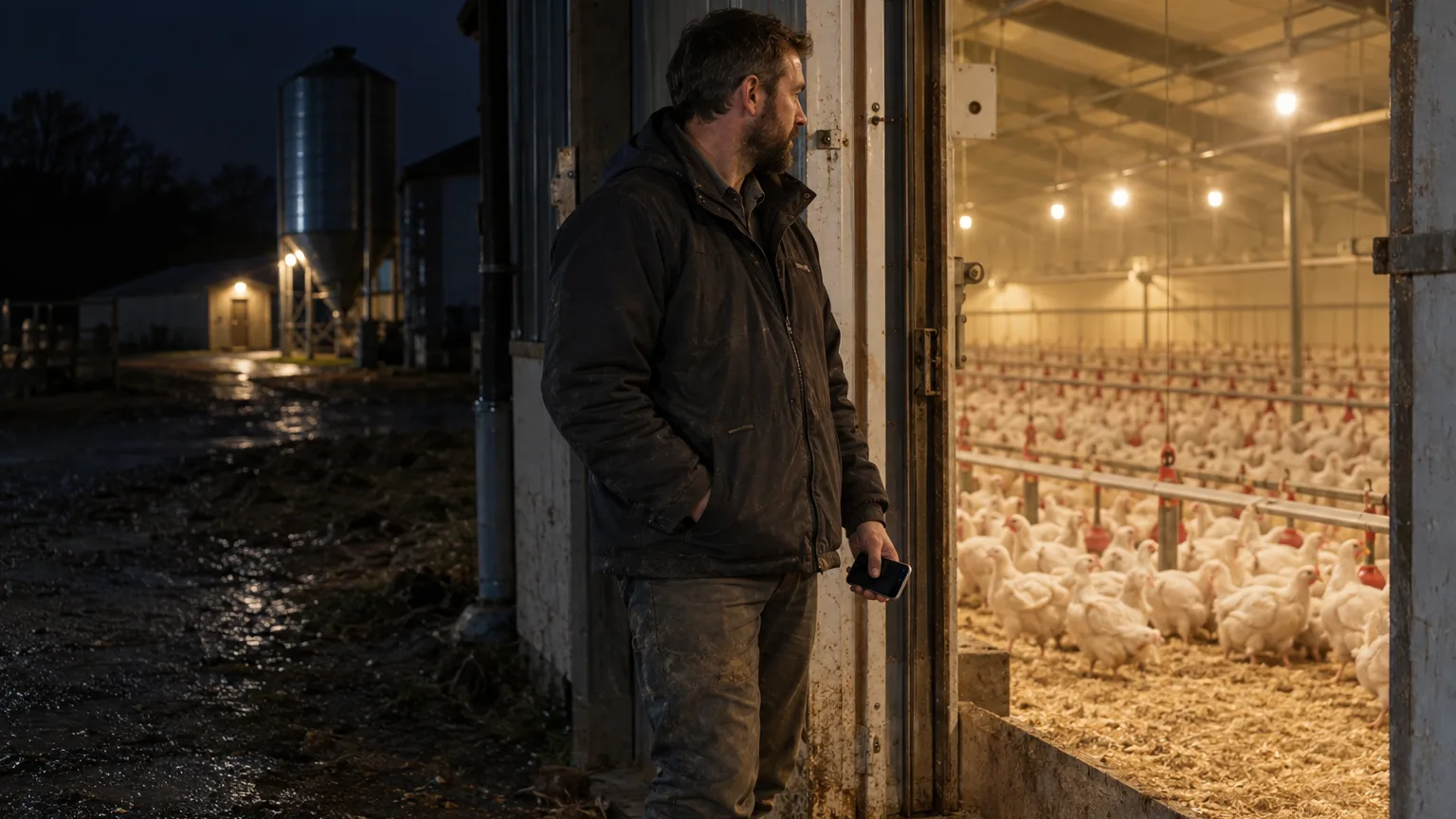
Every poultry house alarm is a decision about one thing: what is worth waking a person for. Set too few and a stopped fan goes unnoticed until the morning. Set too many and by the third week the team has learned to roll over and go back to sleep.
This guide is about designing that list. For what actually happens in the house when the fans stop, and how a current sensor catches it, see what happens when ventilation fails.
Start from what can hurt birds before morning
Draw a line between problems that can cost birds in the next few hours and problems that can wait until the morning round. Only the first group belongs on the night list.
For most houses that list is short:
- A fan that has stopped. The fastest way to lose birds in a full house, especially in hot weather. The controller knows what it switched on, not what is turning, so this needs its own signal: a current sensor on each fan that matters.
- Temperature out of range. Too hot in a full house in summer, too cold in a brooding house in winter when a heater fails.
- CO2 building up. The plainest sign that air exchange has fallen behind, especially on minimum ventilation in a closed house.
- Ammonia building up. Slower than the others, but a night above your limit is one you want to know about.
A dropping water curve or a feed bin getting low are things to see on the dashboard in the morning. They rarely justify a 3 a.m. call.
The alarm has to watch itself
The most dangerous alarm is the one that has quietly stopped working. Three failures look exactly like a quiet night unless the system reports them:
- The controller goes offline. A lost cellular signal, a hardware fault or a damaged cable, and no news looks like good news.
- A battery runs low. You want to hear about it well before it matters.
- A sensor fails. A chewed cable or a loose connector can leave a reading frozen or at zero. A sensor that is disconnected or shorted should show as a fault, not as a number that looks normal.
If the system cannot tell you it has gone blind, every other alarm on the list is worth less than it looks.
Where to set the limits
A limit is the line a reading has to cross to raise an alert. Three rules keep them useful.
Set below the limit you work to. An alert that fires when the house is already over the limit is a record of failure. Set it far enough below that the person who gets it has time to act first. For the air limits themselves, see safe ammonia levels in a poultry house.
Set per house and per stage. A brooding house and a house of birds a few days from catching do not want the same temperature limits. Neither do a tunnel house and an open-sided curtain house. In hot regions, the hot-climate broiler guide covers what to watch in each.
Review after each flock. Look at every alert that fired. If someone got up and found nothing wrong, the limit is too tight or the sensor needs attention. If a problem was found in the morning that should have alarmed at night, the limit is too loose.
A level, or the speed it is moving
A fixed limit says the reading has crossed a line. It says nothing about how fast it got there. A temperature that jumps within minutes of a fan stopping is a different event from one that drifts up across a hot afternoon, even if both cross the same line.
The practical answer is to use both, in different places. Limits decide who wakes up, because they are simple to set and simple to trust. The trend is something you read: the morning look at the chart, where a house that came close to its limit three nights running is telling you something before it breaches. A limit set with sensible headroom catches a fast event early, because a fast-moving reading reaches it quickly.
Alarm fatigue is a design fault
Every alert that fires for nothing makes the next one less likely to get answered. When people start ignoring alarms, the fault is in the alarm design, not in the people.
What keeps the night list credible:
- Mark only the urgent sensors as critical. Fan current and the air readings in a full house, usually. The rest can wait.
- Let each person set quiet hours and mute the alert types they do not handle, while critical sensors still get through at any hour.
- Send a recovery notice. When a reading comes back inside its limits, a second message saying so saves a drive out to a house that has already sorted itself out.
- Fix the noisy sensor, rather than widening the limit until it stops complaining.
Who gets woken, and how they answer
An alarm is only worth what happens after it fires.
- Send it to everyone who can respond. The manager, the house workers on shift, the person who lives closest. One phone on silent should not be the single point of failure.
- Repeat until someone acknowledges it. One notification at night is easy to sleep through. An alert that keeps coming back until a person marks it as seen is much harder to miss.
- One acknowledgement stops it for everyone. The first person to take it owns it, and the rest of the team can go back to sleep.
- Say which house and which sensor. “House 3, fan 2” gets a faster and better-equipped response than a generic alarm.
- Cover every site. If you run houses on more than one farm, the same people and the same rules should cover all of them from one account.
Keep a local siren as well, wired to the gas detectors’ own alarm relays, for the person who is already on the farm.
Test it like a fire alarm
An alarm you have never tested is a guess. On a quiet afternoon, switch one fan off at its isolator and check that the alert reaches every phone that should get it. Walk through who answered, how long it took, and what they would have done next. Do it again when someone joins the team or changes phone.
How Henlytics does it
Henlytics puts a Genesis controller in each house with a CT-100 current sensor on each fan you want to watch, alongside ammonia, CO2, temperature and humidity sensors. You set the limits per sensor and mark the critical ones. Alerts are pushed to the phone of everyone on the farm account and repeat until someone acknowledges them, with a recovery notice when the reading comes back. The controller raises its own alert when it stops reporting or its battery runs low, and a disconnected or shorted sensor shows as a fault. Each person sets quiet hours and mutes what they do not need, and critical sensors still get through. Every house on every site sits in one account, on the Henlytics dashboard. Your climate controller keeps running the house as before; see poultry house monitoring without a new controller.
See the fan and power failure alarm for the current sensor and how it is installed.