Broiler houses in hot climates: what to measure
Broilers in hot climates: open-sided or tunnel house, why air speed cools birds, when humidity stops panting from working, and what to measure at bird height.
Ventilation and alarms 7 min read
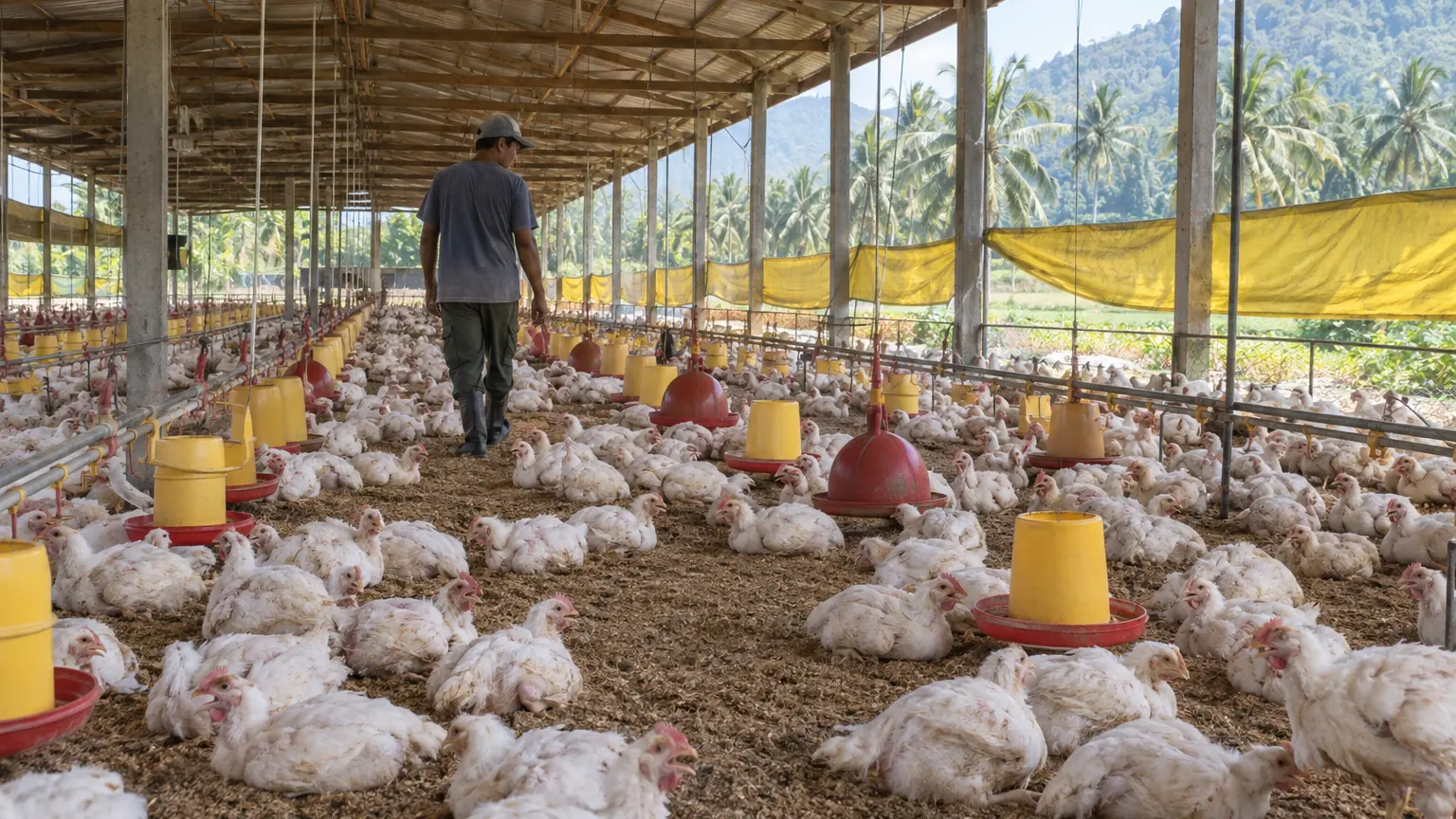
In a broiler house in a hot climate, the risk is not a hot day. It is the combination of a heavy flock in its last weeks, a still afternoon, high humidity and air that moves less than the manager thinks. The trouble starts when the house can no longer remove the heat the birds produce.
This guide is for houses in hot lowlands: open-sided curtain houses and closed tunnel-ventilated houses. It explains why air speed is the main tool, when humidity takes away its effect, what to measure and where, and how to use the heat stress calculator with those measurements.
A broiler does not sweat: it depends on the air around it
A broiler sheds heat two ways: from the body surface into the air, and by evaporating water in its airways when it pants. Mississippi State University Extension puts numbers on it: at a comfortable temperature a bird loses about 5 Btu of heat per pound of body weight per hour from its body surface and about 7 Btu through breathing. As the air near the bird warms, surface loss falls and the bird relies more and more on panting. When panting is no longer enough, core temperature rises, and that is where severe heat stress begins.
That leaves two variables that matter in a hot house:
- Air speed over the birds, which raises heat loss from the body surface.
- Air humidity, which decides how much heat panting can remove.
The thermometer reading is only one of three numbers. A house at 32°C with fast air and moderate humidity can be better off than one at 30°C with still air and high humidity.
Air speed is the main cooling system
University of Georgia Extension states it plainly: air speed is the most effective way to cool birds in hot weather. Moving air creates a wind chill effect on the bird even though the house temperature does not drop.
The Ontario Ministry of Agriculture, Food and Rural Affairs summarises USDA Poultry Research Laboratory trials in Mississippi with seven-week-old broilers:
- Air at 1 m/s over the birds gave growth similar to birds in still air 1°C cooler.
- Air at 2 m/s created a wind chill effect of 3.7°C.
- Birds grown under tunnel ventilation at 2 m/s were 0.5 kg heavier at seven weeks than birds grown in still air.
Targets for modern tunnel houses are higher. Mississippi State says many current tunnel houses manage a minimum of 600 to 700 ft/min, about 3.0 to 3.6 m/s, and that the 400 ft/min that was acceptable a few years ago is no longer enough for today’s larger broilers. Georgia cites a USDA study in Mississippi in which keeping 550 ft/min (about 2.8 m/s) at night gave better weight gain and feed conversion than 300 ft/min or turning the fans off: heat built up during the day still weighs at night, even when birds have stopped panting.
There is a limit. Ontario warns that moving air above 40°C, the chicken’s core body temperature, increases heat stress instead of relieving it. At those temperatures the incoming air has to be cooled.
Open-sided or tunnel: where the air gets lost
In an open-sided curtain house, air moves with the breeze and with whatever fans are inside. In a tunnel house, exhaust fans at one end pull air down the full length of the house. Either way, the practical problem is the same: the air does not reach every bird equally.
- Along the walls. Georgia found air along the sidewalls can run as much as 200 ft/min (about 1 m/s) slower than in the middle of the house. Mississippi reports that houses with smooth, solid sidewalls usually have less than 20% variation between wall and centre, while most curtain-sided houses vary by 30 to 50%, because exposed posts push air off the wall. Its example: with 700 ft/min down the centre and 300 to 400 ft/min near the wall, only about a third of the birds are cooled properly.
- Behind obstacles. Plywood migration fences leave a strip of dead air on the downwind side, where Georgia observed hot birds across a strip of about one and a half metres.
- With fans that underperform. Mississippi notes that dirty shutters can cut airflow by as much as 30%, and a loose belt cannot spin the blade at its rated speed. A fan that is on but not turning properly is air that never arrives. See what happens when poultry house ventilation fails for catching a stopped fan.
In an open house, the roof matters as much as the air. A thesis at the Universidad Industrial de Santander in Colombia simulated a broiler house in a hot tropical climate and found that insulating the ceiling and finishing the roof and facade in white lowered indoor air temperature by 1.23°C in the hottest week of the year, according to its published abstract.
Humidity decides how much panting helps
Evaporative pads and foggers lower air temperature by evaporating water, and in doing so they raise humidity. In a dry climate that is almost pure gain. In hot, humid lowlands the margin is small.
The Ontario ministry gives a clear rule: with evaporative cooling pads in warm weather, relative humidity in the house should never exceed 80%. Birds start to pant to shed heat once the temperature passes about 25°C, and panting works by evaporating water in their lungs; in air above 80% humidity the bird can no longer release that heat.
So a house that cools with water needs to measure humidity, not only temperature. A pad that takes two degrees off the air and pushes humidity past that limit can leave the birds worse off than before.
What to measure, where and when
The three numbers the calculator uses are the same ones worth watching:
- Air temperature at bird height. Not at a worker’s head height and not beside the air inlet. Air warms as it travels down the house, so in a tunnel house the hottest point is usually at the fan end.
- Relative humidity at the same point. Above all if the house uses pads or foggers.
- Air speed over the birds. A handheld anemometer, read in the centre and along the walls at several points down the house, shows where the air does not reach. Repeat it whenever the fans, curtains or flock layout change.
And a fourth signal that often comes before the others:
- Water intake. Hot birds change how much they drink, and a sudden change from one day to the next is one of the first signs that something is going on in the house. See when broiler water consumption drops for reading that curve.
Timing matters as much as place. The useful reading is the hottest afternoon with the heaviest flock, not the morning with small birds.
How to use the heat stress calculator
The heat stress calculator takes temperature, humidity and air speed at bird height and computes the temperature-humidity-velocity index published by Tao and Xin in 2003. The study measured the rise in core body temperature of male market-size broilers, 46 ± 3 days old and 2.8 kg, at 35 to 41°C and 0.2 to 1.2 m/s.
The calculator shows the index and the stress state the study links to it after 90 and after 120 minutes: normal, alert, danger or emergency. The study defined those states by the rise in core body temperature: up to 1.0°C normal, 2.5°C alert, 4.0°C danger and more than 4.0°C emergency.
Three practical ways to use it:
- Compare points in the same house. The same temperature and humidity with 0.5 m/s along the wall and 2.5 m/s in the centre give different indexes. The difference shows which birds are at risk.
- Test the effect of the air. Change only the air speed and see how far the index drops. That is the arithmetic that justifies cleaning shutters or tightening belts before the hot season.
- Treat it as an indication, not a diagnosis. Outside the conditions the study tested, or with younger birds or other types, the calculator says so. For your genetic line and slaughter age, the reference is your breeder’s management guide and your veterinarian.
Measure all day, not only when someone walks in
A reading with a handheld anemometer and thermometer tells you how the house is at that moment. Heat stress builds in the hours nobody is watching: a Sunday afternoon, the power cut that stops the fans, the night after a hot day.
Henlytics measures temperature and humidity in the house continuously and alerts your phone when a reading leaves the range you set, so a hot afternoon is caught while it builds. The same system uses current sensors to check that each fan is turning, and the controller keeps reporting over the cellular network on its own battery when the power goes. See Henlytics for broilers for how it is installed in a house.