Brooding temperature for chicks by weight and humidity
Brooding temperature for broiler chicks from placement to day 27: the breed guide targets by body weight, how humidity shifts them, and where to measure.
Ventilation and alarms 7 min read
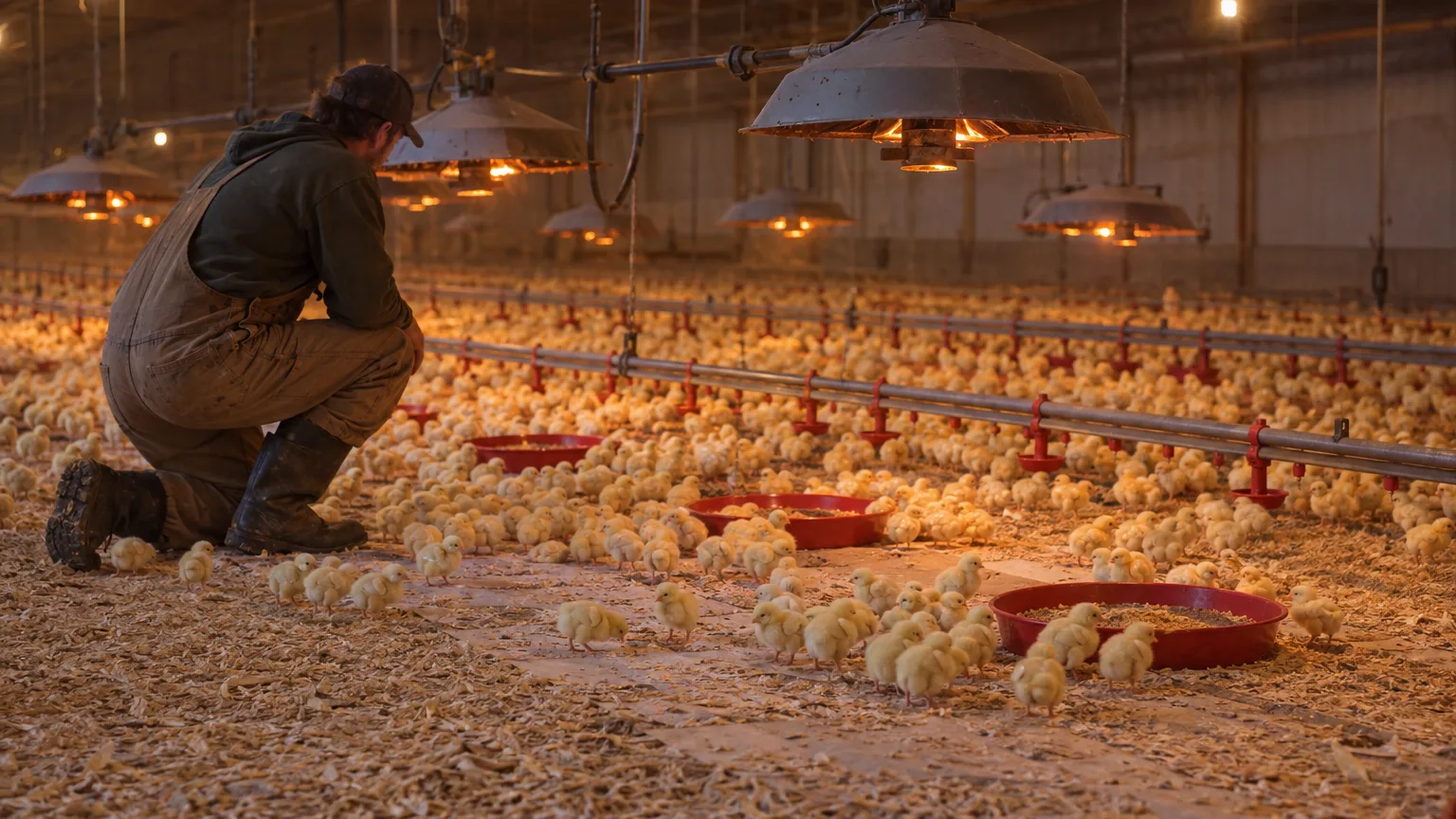
Brooding temperature is the air temperature a broiler chick needs from placement until it can hold its own body heat. A day-old chick cannot do that yet, so for the first days of the flock the house does it for the chick, and the margin for error is small.
This guide sets out the targets in the two main breed management guides, explains why humidity moves them, and covers where to measure so the number on the controller is the one the chicks feel. For the air side of the same period, see CO2 during brooding.
Start warm before the chicks arrive
The house has to be at temperature before the first box is opened, and the floor is the slowest part to get there. Chicks lose heat through their feet, so cold concrete under warm air still chills them.
The Ross Broiler Management Handbook 2025 asks for temperature and relative humidity to be stable for at least 24 hours before delivery, at:
- Air: 30°C for whole-house brooding, 32°C at the edge of the brooder for spot brooding.
- Relative humidity: 60 to 70%.
- Floor: 28 to 30°C before the litter goes down.
- Litter: 28 to 32°C.
The Cobb Broiler Management Guide gives the same picture from the floor up: litter at 30 to 32°C 24 hours before placement with forced-air heating, 40.5°C directly under radiant brooders, concrete below the litter at 28 to 30°C, and preheating started at least 48 hours before the chicks arrive so those targets are reached in time.
The targets come down by weight
Most temperature charts are written by day of age. The 2025 Ross handbook ties them to body weight instead, which follows the flock you actually have rather than the calendar. A slow-starting flock stays warmer for longer; a fast one comes down sooner.
| Body weight | House temperature, whole-house | Spot brooding, brooder edge | Spot brooding, 2 m from edge |
|---|---|---|---|
| 44 g | 30°C | 32°C | 29°C |
| 100 g | 28°C | 30°C | 27°C |
| 180 g | 27°C | 28°C | 25°C |
| 290 g | 26°C | 27°C | 25°C |
| 425 g | 25°C | 26°C | 25°C |
| 590 g | 24°C | 25°C (whole area) | |
| 790 g | 23°C | 24°C (whole area) | |
| 1,015 g | 22°C | 23°C (whole area) | |
| 1,260 g | 21°C | 21°C (whole area) | |
| over 1,530 g | 20°C | 20°C (whole area) |
Source: Ross Broiler Management Handbook 2025, Table 2.4. The handbook bases these figures on 60 to 70% relative humidity up to 3 days of age and 50% after that, and says that after 27 days the temperature should stay at 20°C or follow bird behaviour.
Two adjustments in both guides:
- Small chicks run warmer. Ross sets the starting temperature 1°C higher for chicks from donor flocks under 30 weeks of age or below 35 g at day old. Cobb also adds 1°C for smaller chicks in the first week.
- Spot brooding is a gradient on purpose. The chicks choose their spot between the brooder edge and the cooler ring 2 m out. Whole-house brooding gives them no such choice, which makes getting the one number right more important.
Humidity moves the number
A chick sheds heat by breathing out moisture. When the air is humid it sheds less, so the same thermometer reading feels warmer to the chick; when the air is dry, it feels colder. That is why a house can sit exactly on its temperature target and still have cold, noisy chicks.
The Ross 2025 handbook (Table 2.5) shows how far apart the targets are for the same bird:
| Body weight | 40% RH | 50% RH | 60% RH | 70% RH |
|---|---|---|---|---|
| 44 g | 36.0°C | 33.2°C | 30.8°C | 29.2°C |
| 180 g | 32.5°C | 29.9°C | 27.7°C | 26.0°C |
| 590 g | 29.0°C | 26.8°C | 24.8°C | 23.0°C |
The Cobb guide gives a similar table by age: 34°C at 30% humidity against 30°C at 70% on day 0, and 29°C against 25°C on day 14.
Humidity is not a minor input in a brooding house. Ross notes that whole-house brooding with nipple drinkers can run below 25% relative humidity, while houses with gas spot brooders and bell drinkers usually run above 50%. Below 50% in the first week the house is dry and dusty and chicks start to dehydrate; above 70% from day 7 onward the risk shifts to wet litter. Before changing the temperature setting because of humidity, the handbook says to check the minimum ventilation rate first, since wrong ventilation is a common cause of both high and low humidity.
Measure where the chicks are
A sensor on the wall at head height reads warm air that has risen past the chicks. The Ross handbook is specific about placement for automatic systems:
- Height: at bird level, no more than 30 cm above the floor.
- Spot brooding: 2 m from the edge of each brooder, the cool side of the gradient.
- Whole-house brooding: one sensor in the centre of the house and two more halfway between the centre and each end wall.
- Position: where birds cannot touch them, and out of line with heaters and air inlets.
- Checking: temperature and humidity at least twice a day for the first 5 days, then daily; cross-check electronic sensors with a thermometer and calibrate them at least once per flock.
Cobb adds a simple test of the whole house: daily readings from minimum and maximum thermometers and the controller sensors should not differ by more than 2°C.
Draughts matter as much as temperature. Small chicks have a large surface for their size and lose heat quickly, so Ross keeps air speed at chick level below 0.15 m/s during brooding.
The chicks are the final check
Every guide ends in the same place: the thermometer sets the starting point, and chick behaviour says whether it is right.
Under spot brooders, the Ross handbook describes four patterns. Chicks that are too hot are quiet, pant, droop their heads and wings and move away from the brooder. Chicks that are comfortable spread evenly with a contented level of noise. Chicks that are too cold crowd under the brooder and call in distress. Chicks huddled to one side of the surround are telling you about a draught. In whole-house brooding, where there is no heat source to move toward, comfortable chicks form groups of 20 to 30 and keep moving between them, eating and drinking.
Body temperature gives a second check. Ross targets a vent temperature of 39.4 to 40.5°C. Cobb puts the optimum internal temperature at 40 to 40.6°C, treats below 40°C as too cold, and warns that above 41°C in the first 4 days chicks will pant.
Air quality affects the same behaviour. Ross notes that CO2 above 3,000 ppm and carbon monoxide above 10 ppm make chicks lethargic and stop them eating, which is easy to mistake for a temperature problem. A closed house on a cold night can be warm enough and still short of fresh air.
What to watch through the night
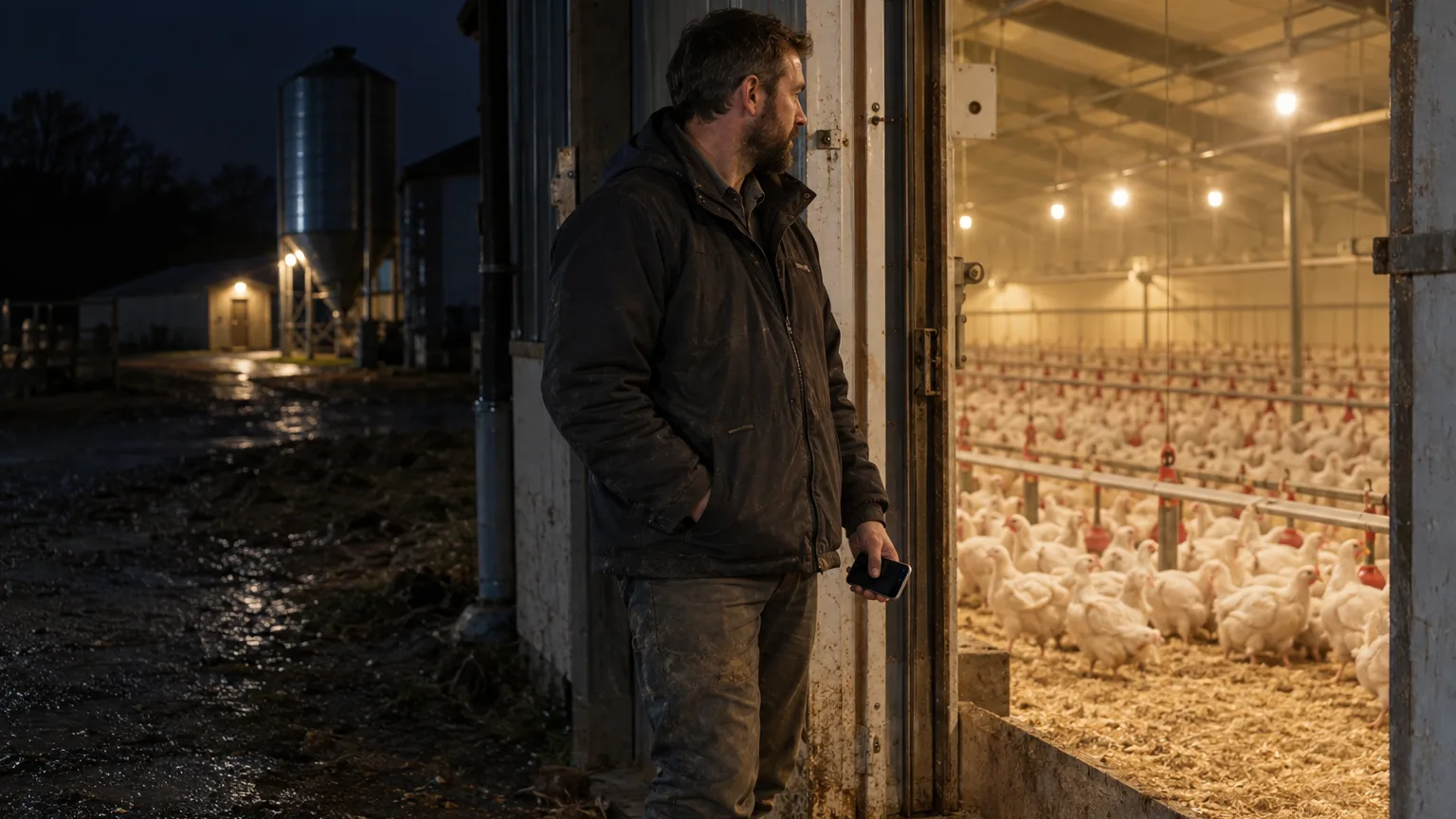
Most brooding problems happen when nobody is in the house: a heater that fails at 3 a.m., a cold front that the heating cannot keep up with, an inlet that opens too far and drops cold air onto the chicks. Daytime checks catch none of them.
A continuous record at chick height shows three things the twice-daily round cannot:
- The overnight minimum, in the hours when the heaters work hardest and nobody is watching the chicks.
- Whether temperature and humidity moved together. A drop in humidity with a steady temperature means the chicks feel colder than the controller thinks.
- How each house compares. Two houses on the same setting that read differently at chick height point to a heater, an inlet or a sensor problem.
Later in the flock the same record serves the opposite risk. When heavy birds face hot weather, the heat stress calculator estimates the load from temperature, humidity and air speed.
How Henlytics measures it
Henlytics reads temperature and humidity at chick height in each house, next to the CO2 and ammonia detectors, and sends every reading by cellular to one dashboard for all your houses. You set the limits for each sensor, and a reading that stays outside them sends an alert to your phone that repeats until someone acknowledges it, followed by a notice when it recovers. It runs alongside the climate controller you already have.
See broiler house monitoring for what Henlytics watches through the flock.