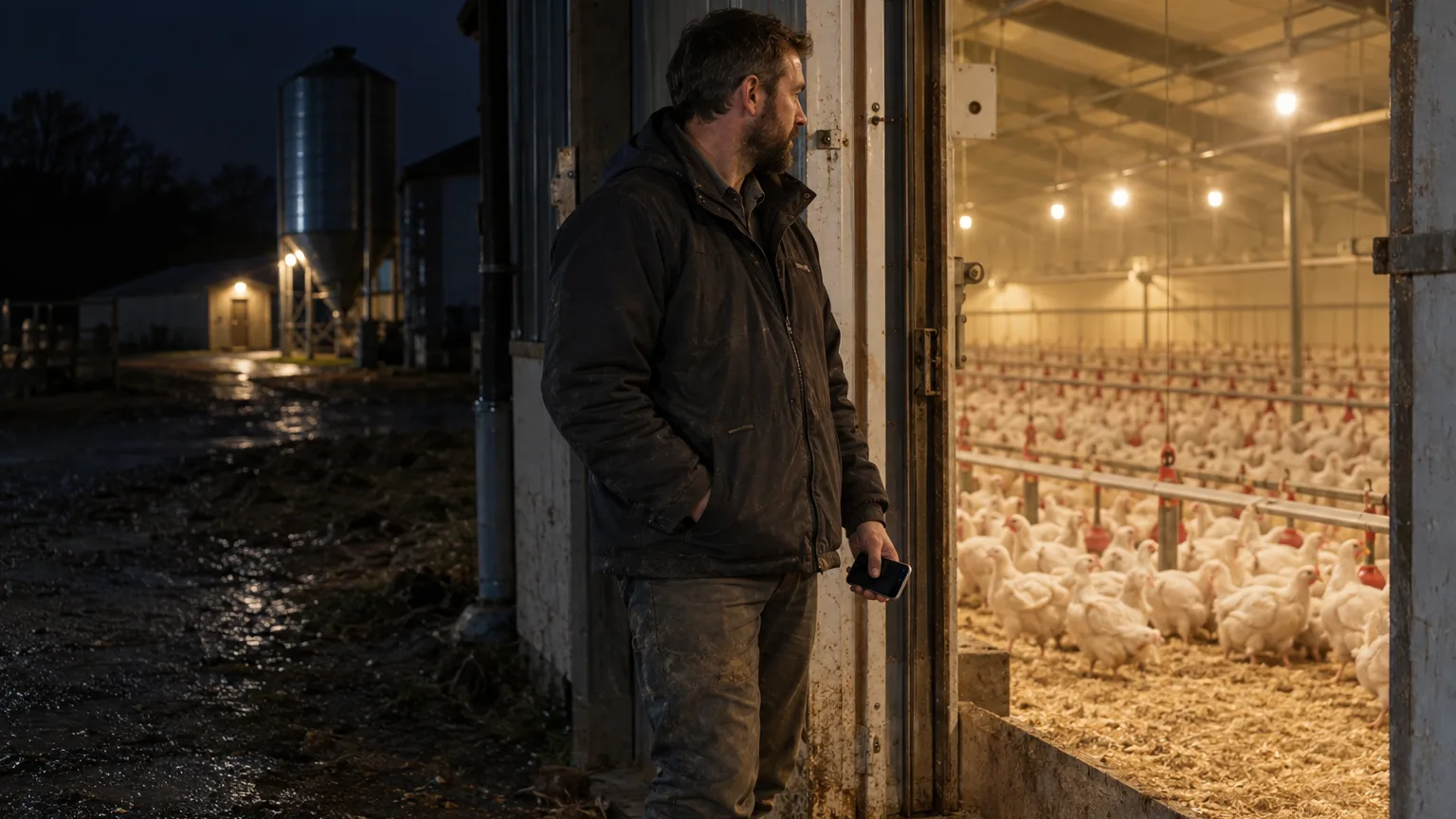
Layer house management: temperature, light and water
What to watch in a laying hen house: temperature, the light program, water intake as the first warning and ammonia, and how each one reaches the lay curve.
Ventilation and alarms 7 min read
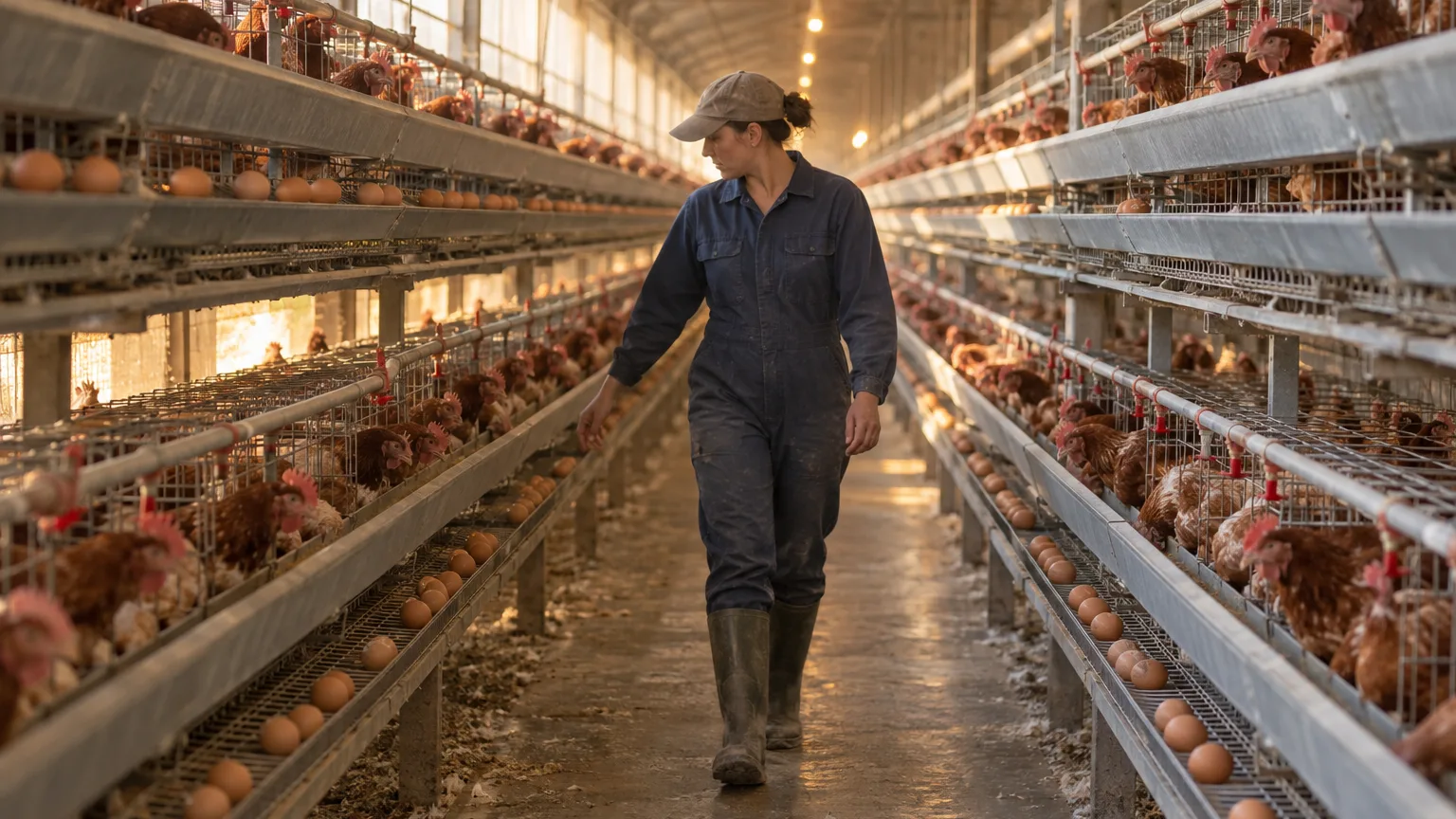
A layer flock spends many months in the same house, and the lay curve is the sum of everything that house put it through. A laying hen house is managed with four measurements you can see every day and a fifth that arrives late: temperature, hours of light, water intake and ammonia, and then the egg. This guide covers what to watch in each, with the figures published in a commercial strain’s management guide, and how to spot a drift before it shows in production.
Lay reacts late, the house warns early
When egg production drops, the cause almost always started days or weeks earlier. A house that ran hot for a week, a light program that slipped by an hour, a drinker line that delivered less water: none of it shows on the egg tray the same day.
That is why a layer house is managed through the indicators that move first. Temperature and humidity change within hours. Water changes within a day. Ammonia changes every night. The egg responds afterwards. Whoever records the first ones can explain the last, and often correct it before it shows.
Temperature: a band, not a number
A hen has a zone in which she holds her body temperature without spending extra energy. Hy-Line’s technical update on heat stress in layers puts that thermoneutral zone between 18 and 25°C, with a normal body temperature of 41°C. Inside that range the bird loses heat by convection, radiation and conduction. Above it she starts to pant to lose heat by evaporation, and that energy comes out of production.
The Hy-Line Brown commercial layer management guide gives the same band for the production house: 18 to 25°C with 40 to 60% relative humidity. It also uses house temperature as a tool to manage feed intake and egg size, with a clear rule: change it by 1°C every two weeks, not all at once.
Three things make the band harder to hold than it looks:
- Humidity counts as much as temperature. The same technical update explains that heat stress is the combined effect of air temperature and humidity, and that raising humidity at any temperature increases the bird’s discomfort. In warm, humid climates, temperature alone misleads.
- Night does not always bring relief. In the evening temperature falls and humidity usually rises. Hy-Line warns that at that point the humidity added by foggers can increase heat stress instead of reducing it.
- Losses depend on how hot and for how long. According to the same source, what heat costs depends on the maximum temperature, how long it lasted, how fast it changed and the humidity. A short peak and a whole afternoon at the same temperature do not cost the same.
Heat does not only lower egg numbers. Hy-Line’s technical update lists feed intake, egg production, egg weight and shell quality among the effects of heat stress, and explains that heat-stressed flocks lay thinner shells because of an acid/base disturbance in the blood caused by panting. A rise in cracked or weak-shelled eggs after a hot week has a concrete explanation.
In practice, record temperature and humidity at bird height, at more than one point in the house, and look at each day’s full history: how many hours the house spent outside the band, not only the maximum.
Light: the program is either delivered or it is not
For layers, light is not only for seeing. The hours of light and their consistency govern the start of lay and how it is held. The Hy-Line Brown guide sums up its program for light-controlled houses in a few rules:
- Light stimulation starts when the flock reaches its target body weight (1.35 to 1.40 kg for that strain), and is delayed if the flock is underweight or poorly uniform.
- The stimulation period extends into the peak, and the flock reaches 16 hours of light at about 30 weeks of age.
- Light hours in the rearing and laying houses should match at transfer, and intensity is raised gradually over the two weeks before.
- Lights are positioned to avoid bright and dark areas, and alternating their height improves light distribution to every cage level.
The exact figures change with the strain, so the reference is always the guide for yours. What does not change is the most common problem: the written program does not match what happens in the house. A clock that fell behind after a power cut, a timer someone moved, a burnt-out lamp at one end of the house. Nobody notices until lay changes.
In open or curtain-sided houses, daylight adds to artificial light and the day changes with the season. Hy-Line offers a customizable lighting program on its site for those cases, which works out sunrise and sunset for the farm’s location.
Water: the first warning
Of the four daily measurements, water warns first. The Hy-Line Brown guide puts it in two sentences worth keeping in mind: when birds drink less, they consume less feed and production quickly declines, and a decrease in flock water consumption is often the first sign of health problems and production drops.
Absolute intake depends on the strain, the age, the temperature and the drinker system, so a table figure is a weak reference. The useful comparison is against the same flock over the previous days. In practice:
- Record water for every house every day, at the same time.
- Look at the last week’s curve, not the single number. A flock in steady lay drinks evenly; a day that breaks the pattern is the signal.
- Check the equipment first: tank, pump, filter, regulator, pressure and nipples. It is the quickest thing to rule out.
- Read water against temperature. A hot house drinks more; a rise in intake alongside an afternoon outside the band has an explanation, a rise without heat may be a leak wetting the manure.
For how to read a drop and what to check, see a drop in water intake as an early warning. The example is broilers, but the logic is the same for layers.
Ammonia: the manure does not leave
In a layer house the manure stays, or is removed in cycles, and while it is there it releases ammonia. The Hy-Line Brown guide gives allowable gas levels at floor level of ammonia below 25 ppm, carbon dioxide below 5000 ppm and carbon monoxide below 50 ppm. Your welfare standard, contract or strain guide may ask for something else, and that is the figure you work to.
Ammonia has two traps. The first is the hour: at night and in cold weather the house sits on minimum ventilation to keep the heat in, and the concentration rises while nobody is inside. The second is the nose: people adapt to the smell within minutes, so the morning impression understates what the birds lived through overnight. A fixed detector does not adapt, and it leaves a record of the whole night.
For where and how to measure it, see safe ammonia levels in a poultry house.
Putting the four measurements next to the lay curve
Each measurement on its own says little. Together they explain the lay curve. A production drop that arrives two weeks after several days outside the temperature band, or after a week in which water fell without a clear cause, stops being a mystery once the house’s history is stored.
That is why the record has to cover the whole flock, not only the current week. A short list for each house:
| What to measure | How often | What to look for |
|---|---|---|
| Temperature and humidity at bird height | Continuously | Hours outside the guide’s band, especially with high humidity |
| Hours of light | Every day | Lights on and off matching the program |
| Water intake | Every day | A day that breaks the week’s curve |
| Ammonia and CO2 | Continuously, with attention to the night | Rises on minimum ventilation |
| Production and shell quality | Every day | Changes that follow any of the above |
Where Henlytics fits
Henlytics monitors layer houses through the whole laying cycle: ammonia, CO2, temperature and humidity where the hens live, current on every fan and feed left in every silo, with alerts on your phone. Each house keeps months of history, so a drop in lay can be traced to what the house was doing. The ammonia detector mounts high on the wall, out of the birds’ reach, and the system works alongside the climate controller you already have.
See layer house monitoring for egg farms for what is installed in a layer house and how alerts reach the team.
Sources
- Hy-Line International, Hy-Line Brown Commercial Layers Management Guide (November 2018).
- Hy-Line International, Understanding Heat Stress in Layers, technical update.