
PAD-100
SKU: BWS-300
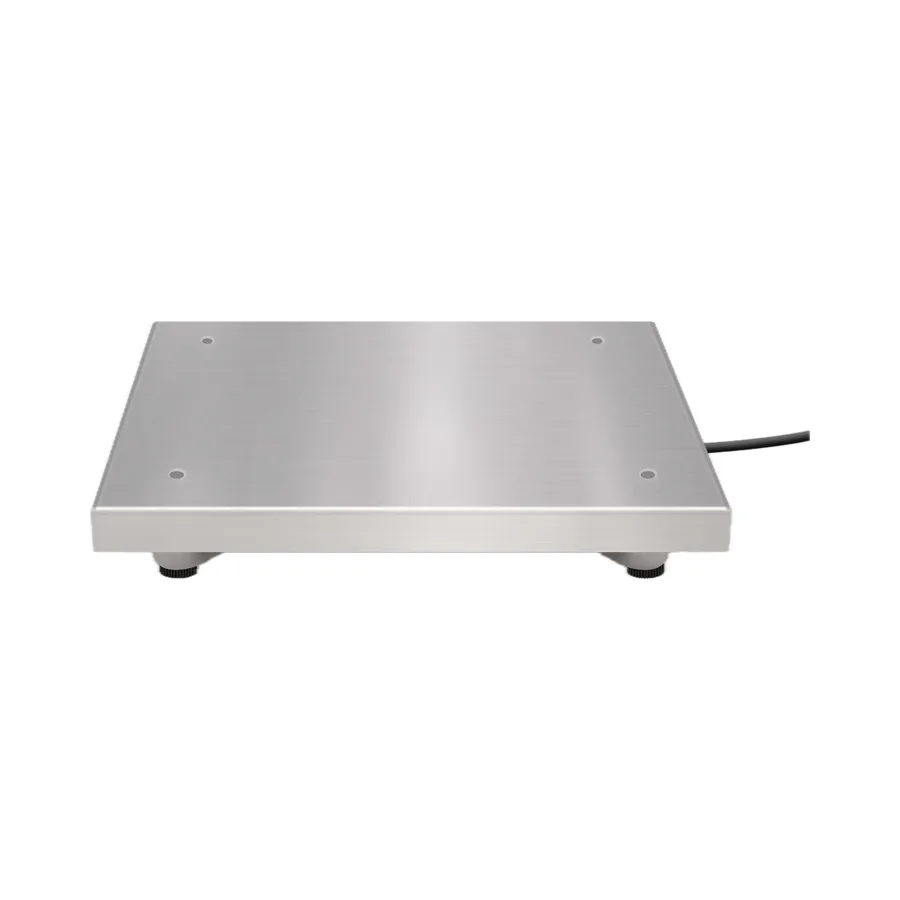
Platform scale hung just above the litter that weighs birds in the house, up to 20 kg at 1 g.
The BWS-300 is an automatic weighing scale for poultry houses. It is a stainless steel platform, 300 × 400 mm, that hangs 2-3 cm above the litter in the area where the birds walk. A bird steps onto the platform, the scale records its weight, and the bird steps off again. Nobody catches a bird and nobody carries a hand scale through the house.
Over a day the platform collects many single weights. Together they give the average body weight of the house for that day, and the next day gives the next point on the growth curve. The scale weighs up to 20 kg with a resolution of 1 g, so the same unit follows a chick through its first week and still has room for a heavy breeder male.
Body weight is what a broiler grower is paid for, and on most farms it is the figure measured least often. Manual weighing means penning and handling a sample of birds, so on most farms it happens once a week. A flock that starts to fall behind on a Tuesday shows it at the next weighing, several days later. In a cycle that lasts only a few weeks, those days are hard to win back.
With a scale in the house the growth curve gets a new point every day. A drop in daily gain after a feed change, a hot spell or the first days of a health problem shows within a day or two, while there is still time to check the feeders, the drinkers and the ventilation.
Breed companies publish a target weight for every day of age. The Ross 308 and Cobb 500 performance objectives are the usual references. A daily average from the scale can be set against the target for the same day, which turns "the birds look fine" into a number of grams ahead or behind.
Processing plants order birds by weight class. A grower who knows the average weight and the daily gain of each house can tell the integrator several days ahead when a house will reach the contract weight, and can plan thinning and the catching crew around a date that holds.
The same record settles the questions that come after the flock has left. When the plant reports a lower weight than expected, the grower has the daily weights of the last week to compare with the weighbridge figure.
In a breeder house weight is controlled, where in a broiler house it is pushed. Feed allocation is decided from body weight against the breed target, week by week, and a flock that drifts above or below the line pays for it later in egg numbers and fertility.
Breeders are weighed by hand as a routine, males and females separately. A scale in the pen fills the days between those weighings, so a feed change can be judged by what the birds did in the following days, before the next weekly weighing. The 20 kg capacity leaves a wide margin for adult males.
Position decides how good the average is. The Ross Broiler Management Handbook 2025 advises placing the platform where many birds gather and where single birds stay long enough to be weighed. In practice that means the open floor between a feeder line and a drinker line, away from the side walls, the doors and the brooders.
Hang the platform level, 2-3 cm above the litter, so that a bird steps up without effort and the platform still swings free. Litter builds up through the flock, so check the height when you walk the house and raise the scale as the litter rises.
A bird scale works in dust, litter and droppings, and it needs a little routine care. Brush the platform clean when you pass it. Check that it hangs free and touches neither the litter nor a feeder leg. With the platform empty the reading should return to zero. A known weight placed on the platform confirms the scale in a minute.
The Ross 2025 handbook advises cross-checking the average of an automatic scale against a manual weighing at least once a week. That check matters most at the end of the flock. Heavy birds move less and step onto a platform less often than light ones, so late in the cycle an automatic average can sit a little below the true flock average. The weekly hand weighing shows the gap, and the catch weight can be planned with it in mind.
Between flocks the stainless steel platform is cleaned with the rest of the house equipment and hung back before the chicks arrive, so the record starts on day one.
The BWS-300 suits floor-reared birds: broilers on litter, and breeders in rearing and in production. The 300 × 400 mm platform has room for a grown broiler to stand with both feet and settle, which is what gives a steady reading. The platform is only 51 mm high and sits on a single-point load cell, a design that weighs correctly wherever on the plate the bird stands.
Most farms start with one scale in each house. Farms that grow males and females apart, or that run long houses with two climate zones, add a second one. Tell us the house size, the bird type and the weight you grow to, and we will suggest how many scales to fit and where to hang them.
Hang the scale in the house so that the platform sits 2-3 cm above the litter. It wires to the Genesis controller over RS485.
The Ross Broiler Management Handbook 2025 advises placing the platform where many birds gather and where single birds stay long enough to be weighed. The BWS-300 platform hangs 2-3 cm above the litter.
The Ross 2025 handbook advises cross-checking the average of an automatic scale against a manual weighing at least once a week.
Broilers and breeders. It weighs up to 20 kg at 1 g resolution on a 300 × 400 mm platform.
PAD-100
Send the number of houses, the birds and what you want to watch. You get a proposed set of sensors per house and a quote, with the datasheets.