Lighting program for laying hens: hours and lux by week
Hours of light and lux by week for laying hens from the Hy-Line and Lohmann guides: rearing, light stimulation, maximum hours and how to measure light.
Flock performance 7 min read
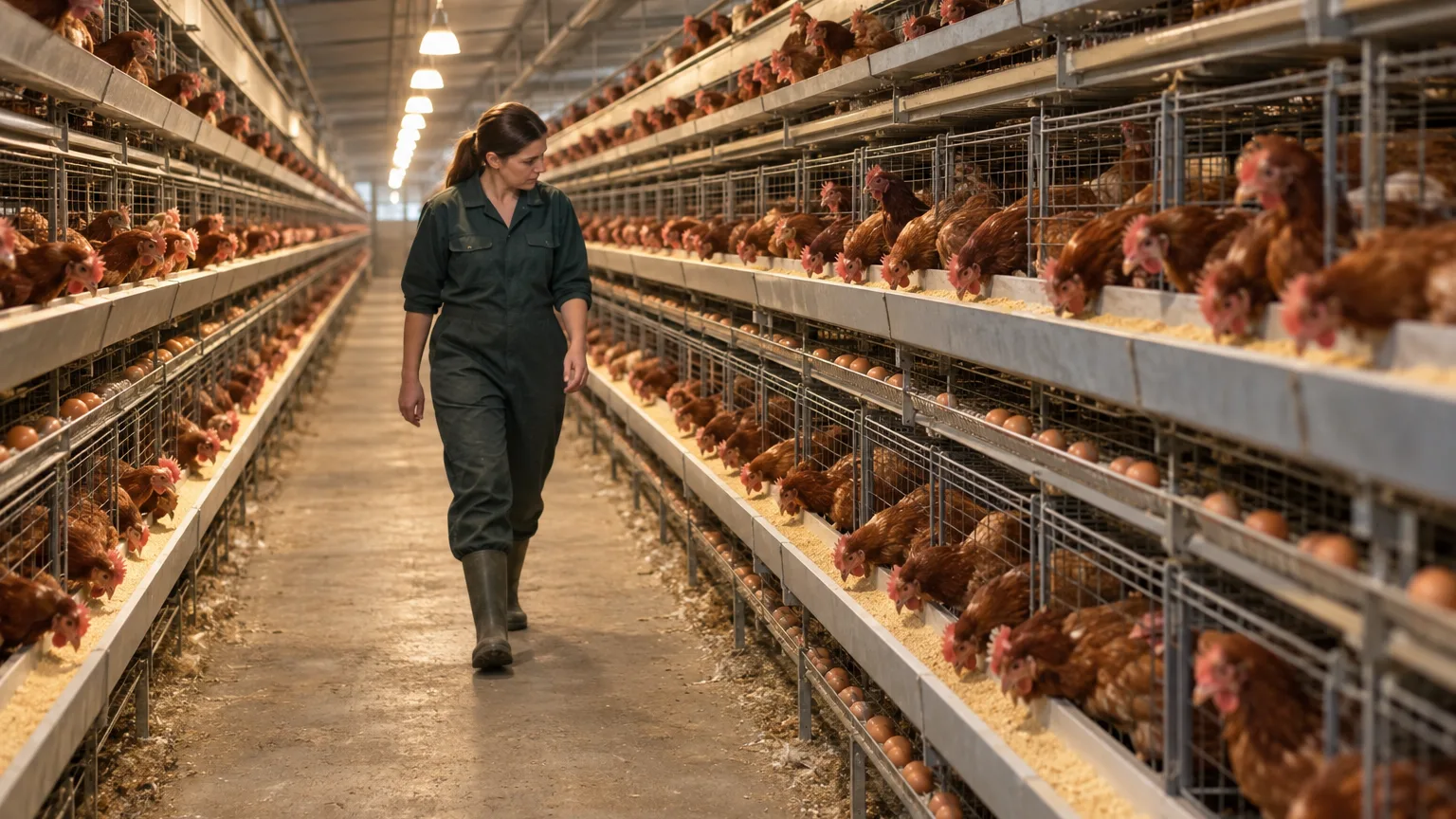
A lighting program for laying hens sets how many hours of light the flock gets each week and how bright it is, from the pullet’s first day to the end of lay. Lohmann puts it in one line in its management guide: the lighting program controls the onset of lay and affects performance. Hours go down or stay flat during rearing and go up to stimulate lay; Hy-Line’s technical update on poultry lighting explains that an increase of as little as one hour has an immediate effect on reproductive hormones.
The figures below are for light-controlled houses, meaning closed, dark houses. They come from the Hy-Line Brown Performance Standards Guide (December 2025), the Hy-Line W-80 Performance Standards Guide (April 2026) and the Lohmann Brown-Classic Management Guide, Cage Housing (edition 08/21, version V01-24).
Never add light in rearing, never take it away in lay
Lohmann writes the basic rules this way: never increase the hours of light during rearing until the planned stimulation starts, and never decrease them during production. Mississippi State University Extension gives the same rule for pullets and hens. The Hy-Line programs follow the same pattern: hours come down to a minimum, stay there until stimulation and only go up after it.
Hours of light by week
| Week | Hy-Line Brown | Lohmann Brown-Classic |
|---|---|---|
| 1 | Intermittent or 20 h | 24 h on days 1 and 2, 18 h on days 3 to 6 |
| 2 | 20 h | 16 h |
| 3 | 18 h | 14 h |
| 4 | 16 h | 12 h |
| 5 | 14 h | 11 h |
| 6 | 12 h | 10 h |
| 7 to 16 | 10 h | 9 h |
| 17 | 11 h | 10 h |
| 18 | 12 h | 11 h |
| 19 | 13 h | 12 h |
| 20 | 13.5 h | 13 h |
| 21 | 14 h | 14 h |
| 22 | 14.5 h | 14 h |
| 23 | 15 h | 14 h |
| 24 | 15.5 h | 14 h |
| 25 onward | 16 h | 14 h |
Sources: Hy-Line Brown guide, light program for light-controlled housing and brooding temperature and lighting table (pages 12 and 9); Lohmann Brown-Classic guide, Table 13. Week 1 is the first seven days of life.
The two programs have the same shape: down quickly in the first weeks, flat through rearing and up from week 17. Lohmann rears on 9 hours and finishes at 14; Hy-Line rears on 10 and reaches 16 at 24 weeks of age. The W-80 guide follows the Brown pattern up to stimulation and climbs faster after it, reaching 16 hours at 22 weeks.
For the first days both companies propose an intermittent program, in blocks of 4 hours of light and 2 of darkness. Hy-Line uses it from 0 to 7 days, and up to 14, because it synchronises the chicks’ rest and feeding and may improve 7-day livability and pullet body weight. Lohmann uses it for up to 7 or 10 days after arrival and notes that weak chicks are prompted to eat and drink by the stronger ones.
The pullet’s weight decides when light goes up
Hy-Line moves the flock to the laying house at 15 weeks and adds the first hour at 16, with body weight as the trigger: 1,350 g for the Hy-Line Brown when the aim is egg numbers and 1,380 g when it is egg weight. For the W-80 it asks for the ideal weight and 85% uniformity, with 1,180 g for early egg numbers and 1,230 g for large eggs. Weekly weights for each strain are in the laying hen production chart by week.
Lohmann presents its standard program as an example for a quick start into production. How far hours are cut in rearing and when stimulation begins are, in its guide, the tools for adjusting performance to each farm.
The maximum is 14 to 16 hours, depending on the strain
Hy-Line Brown adds an hour a week up to 13 hours and then half an hour a week up to 16. Lohmann adds an hour a week, from 9 to 14, and holds 14 hours to the end of production. Hy-Line’s lighting update treats 16 hours as the standard for maximum production, and Mississippi State Extension recommends 16 to 18 hours a day to keep hens laying.
Bright for chicks and for lay, dim for rearing
| Week | Hy-Line Brown | Hy-Line W-80 | Lohmann Brown-Classic |
|---|---|---|---|
| 1 | 30-50 lux | 30-50 lux | 20-40 lux, then 20-30 lux |
| 2 and 3 | 25 lux | 25 lux | 10-20 lux |
| 4 | 25 lux | 25 lux | 4-6 lux |
| 5 to 15 | 10 lux | 5-10 lux | 4-6 lux |
| 16 | 20 lux | 15 lux | 4-6 lux |
| 17 | 20 lux | 15 lux | 5-7 lux |
| 18 and 19 | 20-25 lux | 15-20 lux | 5-7 lux |
| 20 onward | 20-25 lux | 15-20 lux | 10-15 lux |
Sources: Hy-Line Brown and W-80 guides, brooding table and the intensity band of the light program (pages 9 and 12); Lohmann Brown-Classic guide, Table 13.
Hy-Line changes the colour as well: cool, blue-green light (above 3500 K) for rearing and warm, red-orange light (below 2700 K) for lay. Its lighting update explains why: red light stimulates sexual maturity and egg production, because it passes through the skull to the light receptors of the hypothalamus. The same publication sets two general limits: below 5 lux is too dark for proper growth and production, and above 50 lux may cause nervousness. Lohmann works with lower levels in rearing, 4 to 6 lux.
Light is measured where the hen eats
Hy-Line recommends measuring at feed trough level, every 25 cm between lights and on every tier. In a cage or colony house with manure belts that usually takes 30 to 100 readings. In floor houses, measure at the wall, at the feeder and drinker lines under the lights and two or three times between lights, 10 to 50 readings in all.
Uneven light has a concrete cost. In floor houses, shadows become nesting places and floor eggs go up; in cages, some cages get too much light and others too little, so the same house is over and under stimulated at once.
Two details change the reading. Ordinary light meters are calibrated to the human eye, and a hen sees a wider spectrum: depending on the light source, the intensity the bird perceives, measured in clux, can be 50% higher than the meter shows, or more. And an LED can lose output over the years without burning out, so Hy-Line suggests a baseline measurement to know when to replace it.
In open houses the natural day sets the program
The same rules hold in an open house, but the program is built around daylight. Lohmann asks for a program tailored to the season and the farm’s location, and gives an example: at 17 weeks, at least 10 hours counting natural light, then one more hour a week up to 14 hours at 21 weeks. The order matters too: in the evening close the windows first and then switch off the light; in the morning switch the light on first and then open the windows. Hy-Line Brown’s program for open-sided houses rears on 12 hours instead of 10 and also reaches 16.
Intensity is the other problem. Hy-Line warns that even with curtains an open house easily goes above 1,000 lux, and that very bright light can cause nervousness, feather pecking and cannibalism. Near the equator, on the other hand, sunlight varies little from season to season.
In hot weather, light shifts to the morning
Hy-Line’s technical update on heat stress in layers uses the lighting program to get hens eating in the cool hours: more hours of light in the morning and fewer in the afternoon, and a 1 to 2 hour midnight feeding with the lights on. In extreme heat it suggests lowering light intensity during the hottest hours to reduce bird activity, and notes that intermittent programs have also been used successfully to encourage feed intake.