Incubator temperature, humidity and CO2 in a hatchery
Eggshell temperature, humidity, CO2 and ventilation in setters and hatchers, room conditions from the Cobb and Aviagen guides, and what to alarm on.
Hatchery and eggs 8 min read
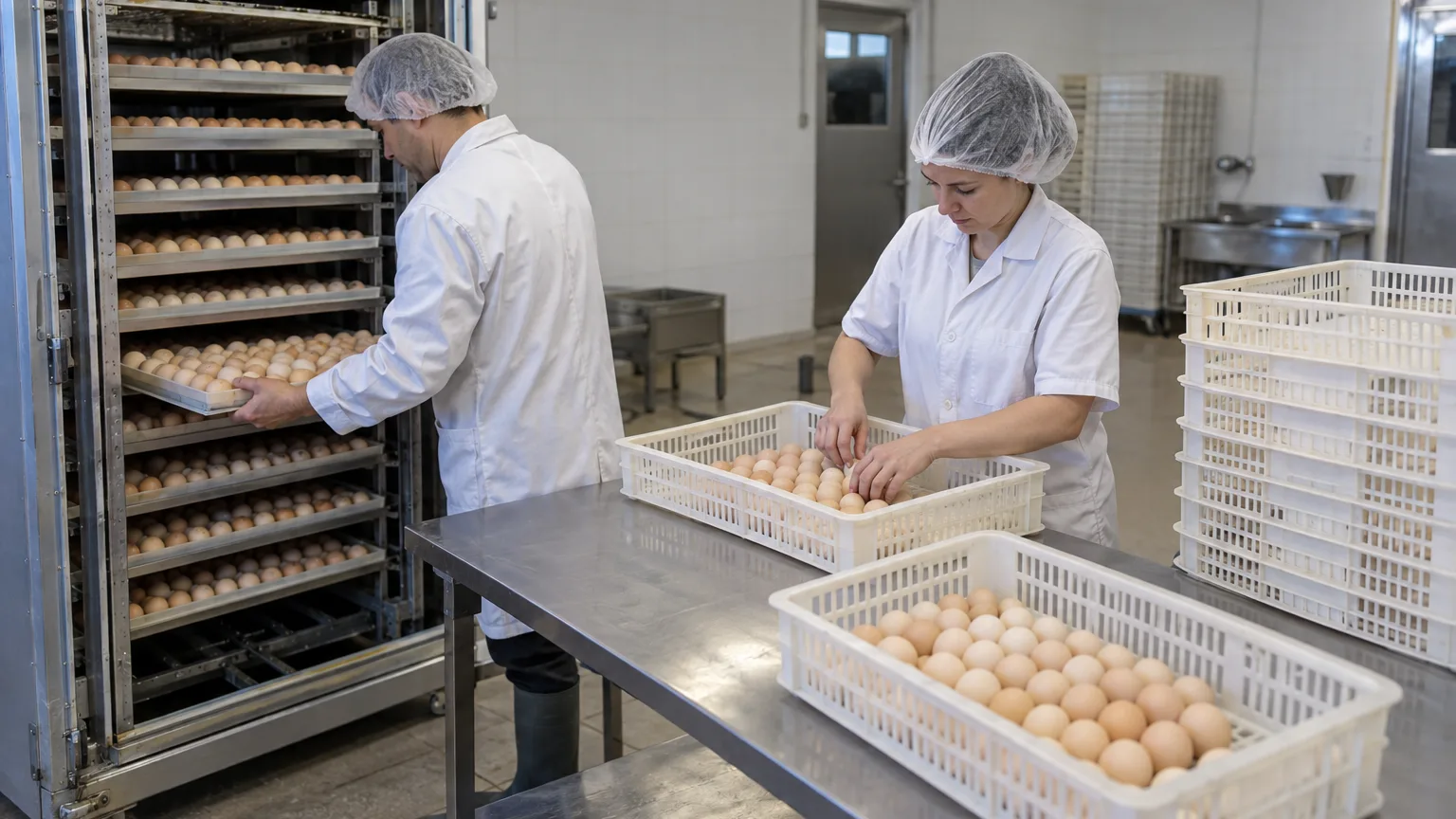
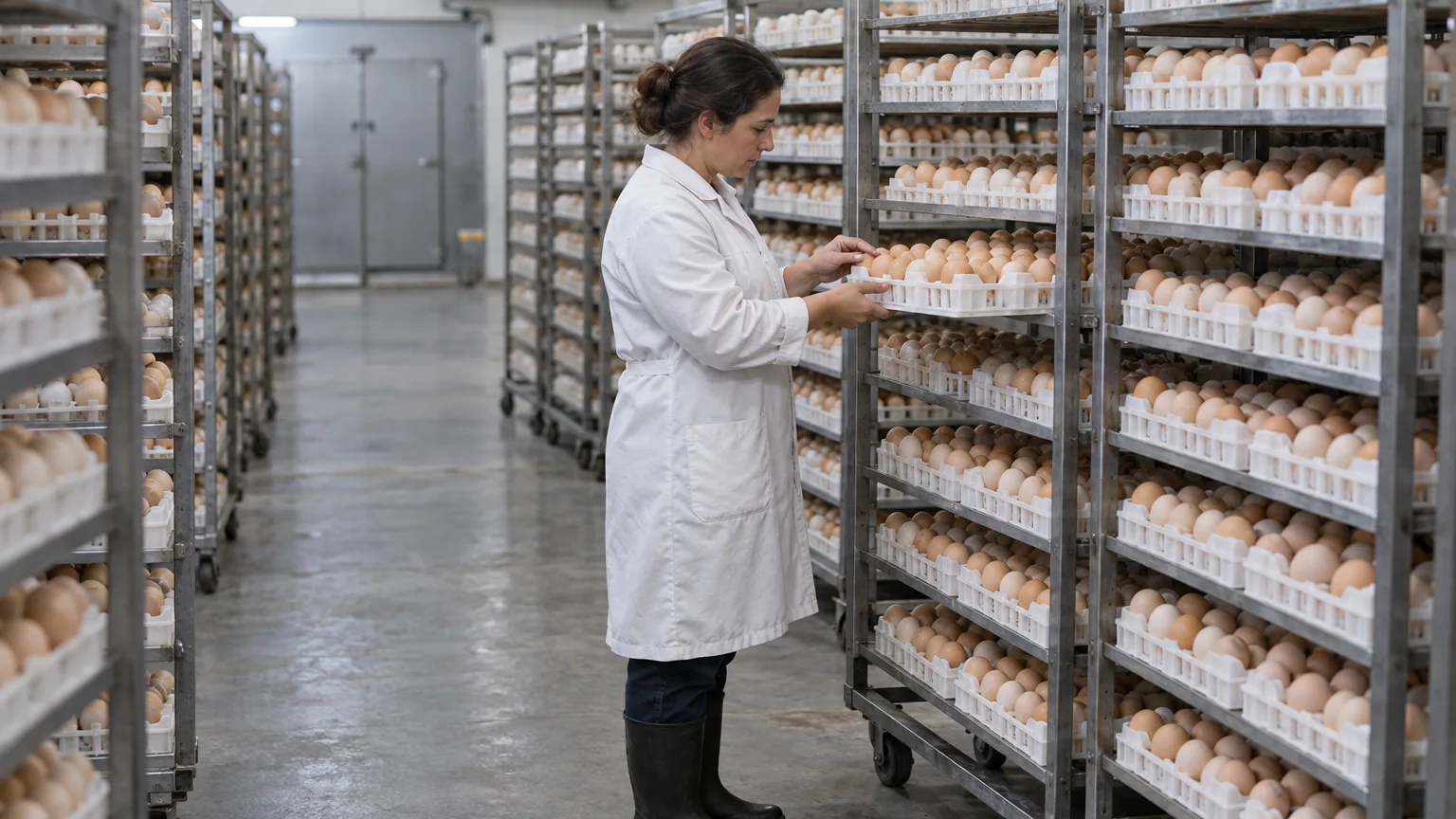
A setter controls its own climate, but only with the air its room gives it. According to the Cobb Hatchery Management Guide (2020), setters draw their fresh air from the room or the plenum they stand in. That air brings oxygen and moisture, and the air leaving the machine carries away the CO2, moisture and heat the eggs produce. The climate of an incubation run therefore has two layers: the targets inside the machines, and the room conditions that let the machines reach them.
Inside the setter, eggshell temperature is what counts
Cobb puts it plainly: what drives embryo development is not the air temperature but the eggshell temperature, which reflects the temperature of the embryo. Its table:
| Eggshell temperature | Result according to Cobb |
|---|---|
| 36.6-37.7 °C | Too cold: slow or poor hatch and poor chick quality |
| 37.7-38.0 °C | Optimum: good hatch and good chick quality |
| 38.0-38.8 °C | Too warm: good hatch, poor chick quality |
| 39.1-40.0 °C | Too hot: poor hatch and poor chick quality |
Aviagen’s Hatchery Tips 2025 targets 37.8 °C (100 °F) on the shell of fertile eggs from day 1 to day 20, within 37.5-38.6 °C (99.5-101.5 °F), and asks for checks on days 2, 15 and 17 at different positions in the machine to find hot and cold spots. Where the shell goes above 38.9 °C (102 °F), action is needed: chicks from overheated eggs hatch earlier, dehydrate more, and come out paler and shorter with bigger yolk sacs.
The heat risk grows towards the end. According to Aviagen, embryos switch from taking up heat to producing it after about 12 days, and by transfer on day 18 they produce so much that the setter has to deliver far more cooling and ventilation. For multi-stage machines, Cobb recommends recording eggshell temperature within the 12 hours before transfer, while there is still time to correct a problem.
Humidity is set by the egg’s water loss
Setter humidity is adjusted so that the egg loses the right amount of water. Aviagen sets the target at 10.5-12.5% of egg weight from lay to transfer on day 18, worked out for every set and allowing for what the egg has already lost in storage. Cobb adjusts the target to breeder age: in multi-stage setters it runs from 10-11% for flocks of 25 to 30 weeks up to 13% or more from 61 weeks.
To get there, Cobb says multi-stage setters typically run at 47-52% relative humidity, depending on the manufacturer and the type of egg. In single-stage setters humidity starts high and is reduced in the later stages of development.
In hot, humid climates the problem is the opposite: outside air brings too much water. Aviagen’s ideal is supply air holding 13.4 g of water per m3, reached by cooling the air to 15.7 °C so the excess condenses, then warming it again before it reaches the setter room.
CO2 and ventilation in the machines
For multi-stage setters, Cobb asks for constant air exchange, adjusted so that CO2 inside the machine does not exceed 0.4% (4000 ppm). Most fixed-rack machines run at 0.2-0.3% and trolley machines at 0.3-0.4%, though Cobb notes these levels are not a requirement. In single-stage setters the damper is shut or nearly shut at the start, opens gradually, and is fully open by the end; the manufacturer gives the curve.
Most modern single-stage setters and hatchers move their dampers by a CO2 sensor, which works only if the sensor reads correctly. Aviagen asks for CO2 sensors to be calibrated every three months and gives a quick check: outside air holds 300-400 ppm, and if the hatchery ventilation is working, corridors and air intake plenums hold 400-600 ppm. An empty machine with its dampers 100% open should read the same as the corridor. If it does not, the sensor is recalibrated or replaced.
A sensor that drifts ventilates wrongly, and Aviagen lists the cost of each mistake:
| Too little ventilation | Too much ventilation | |
|---|---|---|
| Setter | Too little weight loss and late embryo mortality | Too much weight loss and cold spots |
| Hatcher | Excessive chick yield, navel problems, late mortality and ascites | Cold spots, a wide hatch window and dehydration |
The hatcher: cooling as the chicks come out
After transfer, the hatcher’s job is to keep the chicks that have hatched from overheating. According to Cobb, almost all hatchers run between 36.7 and 36.9 °C at transfer, and the temperature is lowered gradually as chicks emerge. Cobb’s Hatcher Management Program (2025) starts lowering when about 25% of chicks have hatched and stays at or above 36.1 °C (97 °F) until at least 75% have. Aviagen’s checklist asks for 36.7 °C (98 °F) or less after transfer and 36.1 °C (97 °F) or less at the end.
The chick is the guide. Cobb gives 40.0-40.6 °C as the normal cloacal temperature. At 41.1 °C a chick starts to pant and dehydrate; below 39.4 °C chicks huddle. When chicks run hot, Cobb works in a set order: first lower the hatcher temperature, then the temperature of the hatcher hallway, and last the negative pressure in the exhaust plenum. For the hallway it gives:
| Hours before take-off | Hatcher hallway temperature |
|---|---|
| At transfer | 26 °C |
| 12 | 25 °C |
| 8 | 24 °C |
| 4 | 23 °C |
Humidity moves during the hatch too. Cobb gives about 52-54% relative humidity for the first 24 hours after transfer. Humidity rises as chicks pip and falls again once most have hatched; as the temperature is lowered, the wet bulb setting comes down with it so that relative humidity stays constant. Aviagen uses the same humidity curve to read the hatch window without opening the machine, and asks for the window to stay below 30 hours.
Hatcher CO2 rises as the chicks breathe. Cobb warns that high CO2 can make chicks lethargic and affect heart and lung development, and opens the damper to 50% 24 hours before take-off, 75% at 18 hours and 100% at 12 hours. Aviagen advises against high CO2 set points at the end of the hatch.
The rooms around the machines
Both guides give conditions for each room, and they do not quite agree:
| Room | Cobb (2020) | Aviagen (2025) |
|---|---|---|
| Egg store | 15-19 °C, 60-65% RH | 15 °C; ventilate if RH goes above 90% |
| Setter room | 24-27 °C, 55-62% RH | 22-28 °C, 50-60% RH, CO2 below 1000 ppm |
| Transfer room | 24-27 °C, 55-62% RH | Pressure below the setter room and above the hatcher room |
| Hatcher room | 24-27 °C, 55-62% RH | 22-28 °C, 50-60% RH, CO2 below 1000 ppm |
| Chick holding room | 23-28 °C depending on air speed, 65-70% RH | 22-28 °C, 50-65% RH, CO2 up to 2000 ppm |
For air volume, Cobb asks for 5-8 cfm (8.5-13.5 m3/h) per 1000 eggs into the setter room and 10-17 cfm (17.0-28.9 m3/h) per 1000 eggs into the hatcher supply plenum, with the air entering the machines pre-humidified and at 24-27 °C. For the chick room, Aviagen gives 85 m3 of fresh air per hour for every 1000 chicks, and its checklist aims for less than 1500 ppm of CO2.
The room matters because of what it does to the machine. Aviagen explains that unstable room conditions force setters and hatchers to work harder to hold their own, and in doing so they create hot and cold spots that affect embryo growth and raise energy use. It also asks for temperature, humidity and CO2 to be even across the plenum, for doors to be kept closed, and for empty hatchers never to be washed while a hatch is still running in the same room, because of the humidity and contamination that brings. In one log Aviagen shows, a setter room with a sound average ran warm for several hours each day because doors were left open, which the average did not reveal.
What to alarm on
Cobb is explicit about the basics. Every hatchery must have an automatic standby generator, with alarms that indicate a power or systems failure and alert the staff. Every setter and hatcher should have a secondary high and low temperature alarm that works independently of both the mains and the machine’s own controls, above all the hatchers, where a component failure can lose the chicks very quickly. The generator is tested every 7 days, under load, for at least 30 minutes, and every use is logged. Among the uses of alarms, Cobb lists temperature and humidity in setters and hatchers, power failures, turning failures, pressure or ventilation out of range and doors left open, and asks for the alarm records to be reviewed to find the faults that keep coming back.
The machines carry their own alarms. On the room side, using the figures from the guides, alarms are worth setting for:
- room temperature and humidity outside their band, for example 22-28 °C and 50-60% in setter and hatcher rooms per Aviagen;
- room CO2 above 1000 ppm in the machine rooms, or 1500 to 2000 ppm in the chick room;
- an egg store above its working temperature or above 90% humidity;
- a hatcher hallway outside the step it should be on for that point in the hatch;
- a supply or exhaust fan that has stopped;
- a mains failure that leaves every fan at zero, the sign that the generator did not start or did not take the load;
- a controller that stops reporting.
Henlytics covers that room side: temperature and humidity probes in each room and at the machines’ air intakes, a CO2 detector in the machine rooms and the chick room, and a current sensor on each fan, with a controller that keeps sending from its own batteries through a power cut. Alerts reach your phone and repeat until someone acknowledges them. For the egg store, the settings by days in store are in hatching egg storage temperature and humidity.