Laying hen production chart by week
Lay rate, egg weight, feed, water and body weight of laying hens week by week, from the Hy-Line and Lohmann guides, and how to read a drop.
Flock performance 7 min read
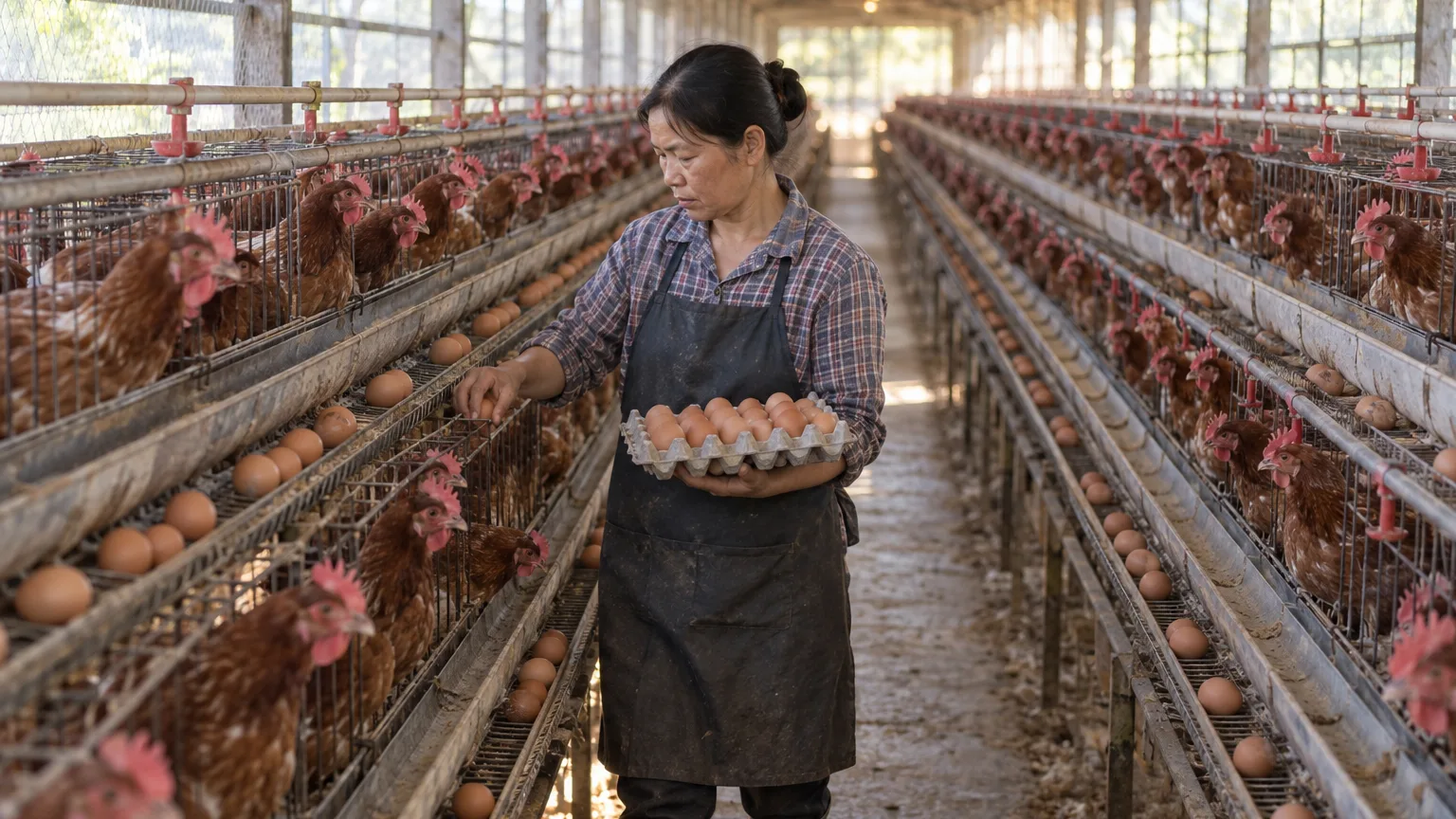
A laying hen production chart gives, for each week of age, what the breed company expects from a well-managed flock: hen-day production, egg weight, feed and water intake, and body weight. Every strain publishes its own in its management guide, and comparing each week’s records with that curve is the most direct way to tell whether a flock is on track.
The figures below come from three current guides for cage and conventional systems: two brown strains, Hy-Line Brown and Lohmann Brown-Classic, and one white, Hy-Line W-80. Hy-Line gives each value as a range; Lohmann gives a single figure.
Lay goes from first egg to 90% in six weeks
Hen-day production is the number of eggs laid in a day divided by the hens alive that day, times 100.
| Week | Hy-Line Brown | Lohmann Brown-Classic | Hy-Line W-80 |
|---|---|---|---|
| 19 | 24.0-25.2% | 9.0% | 6.5-6.7% |
| 20 | 52.5-55.0% | 36.4% | 42.5-44.2% |
| 22 | 87.0-91.2% | 71.9% | 81.8-85.2% |
| 24 | 92.4-97.0% | 87.9% | 89.8-93.5% |
| 26 | 93.6-98.5% | 92.9% | 92.5-96.3% |
| 30 | 93.3-98.2% | 95.1% | 94.3-98.1% |
| 40 | 91.9-97.2% | 94.6% | 93.1-96.9% |
| 50 | 90.0-95.6% | 92.0% | 91.4-95.1% |
| 60 | 87.4-93.2% | 88.4% | 89.7-93.4% |
| 70 | 83.6-89.8% | 84.4% | 88.1-91.7% |
| 80 | 79.7-86.1% | 79.2% | 85.2-88.7% |
| 90 | 75.4-82.0% | 73.2% | 81.8-85.2% |
| 100 | 70.8-77.6% | 66.5% | 78.4-81.6% |
Sources: Hy-Line Brown Performance Standards Guide, conventional systems (December 2025), production period table; Lohmann Brown-Classic Management Guide, Cage Housing (edition 08/21, version V01-24), Table 18, rate of lay per hen-day; Hy-Line W-80 Performance Standards Guide, conventional systems (April 2026). All three give a figure for every week to 100; this is a selection.
The three curves share a shape. Between weeks 19 and 25 the flock goes from its first eggs to over 90%, holds near the peak for some weeks and then declines slowly to the end of the cycle. Hy-Line Brown reaches 50% production at 139 days of age, Hy-Line W-80 at 142 and Lohmann Brown-Classic at 140 to 145. For the peak, the guides give 93.6 to 98.5% for Hy-Line Brown, 94 to 96% for Lohmann Brown-Classic and 94.4 to 98.2% for Hy-Line W-80.
Eggs keep getting heavier after peak lay
| Week | Hy-Line Brown | Lohmann Brown-Classic | Hy-Line W-80 |
|---|---|---|---|
| 20 | 47.6-50.5 g | 46.1 g | 47.2-48.7 g |
| 22 | 50.6-53.7 g | 51.1 g | 50.6-52.1 g |
| 24 | 53.1-56.4 g | 55.3 g | 53.5-55.1 g |
| 26 | 55.2-58.6 g | 58.2 g | 55.8-57.5 g |
| 30 | 58.0-61.6 g | 61.6 g | 58.9-60.7 g |
| 40 | 60.2-63.9 g | 64.6 g | 61.8-63.6 g |
| 50 | 60.5-64.3 g | 65.7 g | 62.7-64.6 g |
| 60 | 60.9-64.6 g | 66.4 g | 63.2-65.1 g |
| 70 | 61.2-65.0 g | 67.0 g | 63.5-65.5 g |
| 80 | 61.5-65.4 g | 67.5 g | 63.7-65.7 g |
| 100 | 62.2-66.1 g | 68.1 g | 63.9-65.9 g |
Sources: the same three guides, average egg weight for each week.
Egg weight climbs fast while lay rises and much more slowly after week 40. The strains do not agree with each other: at week 50 the Lohmann Brown-Classic target of 65.7 g sits above the whole Hy-Line Brown range of 60.5 to 64.3 g. That is why each flock is compared with the guide for its own strain.
Feed and water rise with lay
| Week | Feed, Hy-Line Brown | Water, Hy-Line Brown |
|---|---|---|
| 17 | 77-82 g | 115-163 ml |
| 18 | 81-86 g | 121-173 ml |
| 20 | 91-98 g | 137-197 ml |
| 22 | 101-108 g | 152-216 ml |
| 24 | 107-114 g | 161-228 ml |
| 26 | 109-117 g | 164-234 ml |
| 28 to 100 | 110-118 g | 165-236 ml |
Source: Hy-Line Brown Performance Standards Guide (December 2025), rearing and production tables, per bird per day.
Intake levels off around week 28. The lighter Hy-Line W-80 reaches 107.0-110.8 g of feed and 160.6-166.2 ml of water per bird per day from week 41. Lohmann expects 110 to 120 g a day for the Brown-Classic on a feed of 11.4 MJ/kg metabolisable energy, with the house at 20°C and good feather cover.
In the Hy-Line Brown table, water works out at 1.5 to 2 times feed: 165 ml against 110 g, 236 ml against 118 g. Lohmann states the ratio directly: at comfortable temperatures, 1.8 to 2 parts water to 1 part feed, rising to as much as 5 to 1 above 30°C. That is why a day’s water figure is read together with that day’s temperature.
A hen puts on most of her weight before week 30
| Week | Hy-Line Brown | Lohmann Brown-Classic | Hy-Line W-80 |
|---|---|---|---|
| 17 | 1,357-1,434 g | 1,421 g | 1,212-1,269 g |
| 20 | 1,524-1,611 g | 1,635 g | 1,336-1,400 g |
| 26 | 1,810-1,913 g | 1,893 g | 1,495-1,570 g |
| 30 | 1,864-1,971 g | 1,921 g | 1,554-1,636 g |
| 50 | 1,938-2,049 g | 1,972 g | 1,613-1,712 g |
| 70 | 1,954-2,066 g | 2,021 g | 1,626-1,740 g |
| 100 | 1,965-2,078 g | 2,061 g | 1,646-1,783 g |
Sources: Hy-Line Brown and W-80 Performance Standards Guides, rearing and production tables; Lohmann Brown-Classic guide, Table 17, average weight.
A Hy-Line Brown goes from 1,357-1,434 g at 17 weeks to 1,864-1,971 g at 30, and adds only about 100 g more by week 100.
Weight at the end of rearing decides when the light goes up. Hy-Line Brown starts light stimulation at 1,350 g when the aim is egg numbers and at 1,380 g when it is egg weight; the full program is in the lighting program for laying hens. Lohmann asks for diets to be changed by body weight rather than age, with pullets weighed at regular intervals. At transfer, Hy-Line allows for a normal loss of 10 to 12% of body weight from reduced water intake.
A week off the curve is explained by water, feed, heat and light
The guides present their tables as targets. Hy-Line warns that its strain’s potential is only realised with good management and that local environmental and disease conditions vary, so a flock a little under the range is not an alarm in itself. What tells you something is the change from one week to the next, against the curve and against earlier flocks in the same house. Lohmann asks for health, temperature, ventilation, feed and water intake, lighting and mortality to be checked at least once a day, and those are the records a drop is read with.
- Water falls, then feed. Lohmann explains that water and feed intake are closely linked: if birds do not drink enough, for whatever reason, they eat less, and a hen short of the nutrients she needs loses production. The supply is the first thing to rule out: tank, filter, pressure and drinkers.
- Water rises and feed falls. That is the heat pattern: the hen eats less and drinks more to cool down. Hy-Line’s technical update on heat stress in layers puts the water-to-feed ratio at 2 to 1 at 21°C and 8 to 1 at 38°C, and lists lower feed intake, lower production, smaller eggs and poorer shells among the effects of heat. It adds that at less extreme temperatures heat is often overlooked as the cause of small losses in lay and shell quality. The temperature band for the house is in layer house management: temperature, light and water.
- Feed rises and lay does not. Cold moves intake too. Lohmann explains that low temperatures raise the energy a hen needs for maintenance, and Hy-Line works out about 2 kcal more per bird per day for each 0.5°C below 22°C.
- Lay falls while water and feed hold. Check the lighting program. Lohmann’s rule is never to reduce the hours of light during production, and Mississippi State University Extension notes that with otherwise proper management, the most common reason for a drop in lay is a reduction of light.
- Eggs fall short of the chart’s weight. Lohmann explains that egg weight rises when feed intake is stimulated, and that rearing pullets to a higher body weight and frame size raises egg weight through the whole laying period. Heat brings it down as well.
The house record shows what happened before the drop
Henlytics records every layer house continuously: temperature and humidity where the hens live, ammonia and CO2 and, when the water line has a meter per house connected, each day’s water. When lay moves off the curve, that record shows what the house went through the week before; see layer house monitoring for egg farms.