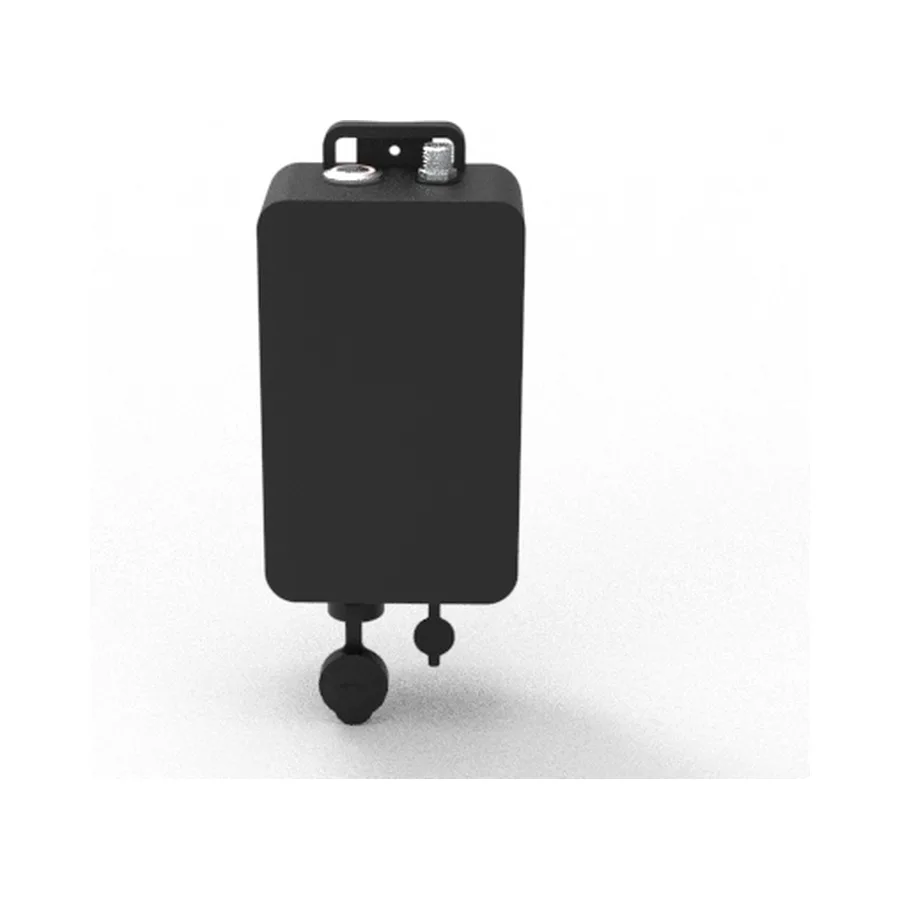
Genesis Lite
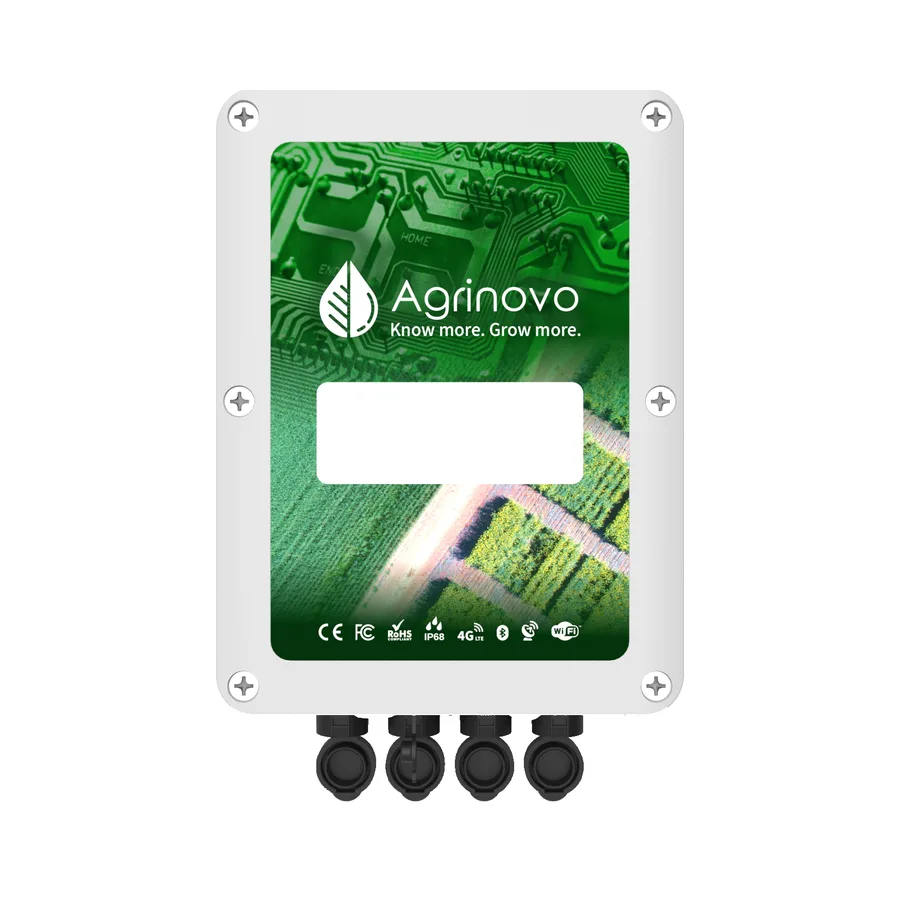
SKU: Genesis
Reads the sensors of one house and sends the readings over the cellular network.
The Genesis is the box on the wall that the sensors of a poultry house plug into. It has four sensor ports along its lower edge, two rechargeable batteries inside and a cellular modem. It powers the sensors, reads them on a schedule and sends the readings out over the 4G-LTE mobile network, where the grower sees them on a phone or a computer.
It is a separate piece of equipment from the climate controller that runs the fans, the heaters and the inlets. That controller keeps running the house exactly as it does today. The Genesis has its own sensors and does not need to connect to the house controller, so it can be added to a house of any age and any make of equipment without touching the existing panel.
The enclosure is rated IP65, which means it is dust-tight and resists water, and it works from -20 to 70 °C. Those two figures matter in a poultry house, where the air carries dust and the service room is rarely heated or cooled.
Each port is a keyed connector that carries power and data to a sensor. Any port takes any sensor of the range: a temperature and humidity sensor, an ammonia or carbon dioxide sensor, a water meter on the supply line, a level sensor on the feed silo, a bird scale in the litter, a current sensor on a fan motor. What a port reads is a setting, made remotely, so a port that read an ammonia sensor during one flock can read a water meter in the next without a visit and without new firmware.
A port is not limited to one sensor. Sensors of the wired digital type share a single cable run, each with its own address, so one port can serve a line of several sensors down the length of the house. The ports cover the common sensor interfaces, namely RS485 (Modbus-RTU), analog, digital, I2C, 1-Wire and SDI-12, which is why sensors already on the farm can often be connected as well.
The controller feeds each sensor at 5 V or 12 V, as the sensor requires, and switches that supply on only while it takes a reading. A sensor that is powered for a moment in each cycle uses a small fraction of the energy of one that is powered all day, which is what lets the whole installation run from two batteries.
The Genesis runs on two rechargeable 18650 lithium-ion cells. They are kept charged through an input that accepts 6 to 32 V DC, either from a fixed DC supply in a house with mains power or from a solar panel. The controller manages the charging itself. Between readings it sleeps, and in sleep it draws less than 30 µA.
This arrangement decides what happens on the worst day of the year. When the mains supply to a house fails, the fans stop and the climate controller may go dark with them. If the generator does not start, the temperature in a house of grown birds begins to climb. The Genesis is already running on its batteries and notices no change. It goes on reading the temperature, the air and the fan currents, and it goes on sending, because the cellular modem does not depend on a router or a network switch in the farm office.
The grower receives an alert on the phone when a reading crosses the limit set for it, and the alert repeats until someone acknowledges it. There are also alerts for the controller itself: one when it goes offline and one when its battery runs low. A house that goes silent is therefore reported as well.
Most poultry houses were built without a data cable, and many stand a long way from the farm office. The Genesis connects on its own over 4G-LTE wherever there is mobile coverage, so nothing has to be dug across the yard and no Wi-Fi has to reach the house. Wi-Fi at 2.4 GHz and Bluetooth 5.0 are built in as well, for sites that have a local network, and the hardware supports modular external modules such as LoRa/LoRaWAN.
Mobile coverage inside a steel-clad building is weaker than in the yard. Before fixing the controller, check the signal at the exact spot with a phone held against the wall. If the service room is poor, the gable wall outside or a spot near a window is usually better, and the sensor cables can be run to it.
The controller keeps a local log of its readings and synchronises it, so a short loss of signal does not leave a hole in the record of the flock. Its firmware is updated over the air, with no visit to the farm.
Mount the Genesis vertically on the wall with the connectors facing down, so that water and dust run off the enclosure and away from the ports. Choose a place within cable reach of its sensors. In most houses that is the service room or the end wall next to it, where the water line, the fan panel and the feed line all arrive.
Start from what the house has to report. A common first set is the climate at bird height, the air quality, the water the house uses, the feed left in the silo and the state of the main fans. Because several sensors can share a port, the four ports are usually divided by direction: one cable run into the bird area for the climate and air sensors, one to the water meter, one to the fan panel for the current sensors and one out to the silo.
A long house, or a house where the silo and the fan panel stand at opposite ends, can take a second controller, so that no sensor cable has to run the full length of the building. On a multi-house farm each house has its own controller and its own batteries. A fault in one house then leaves the others reporting.
The Genesis is the model for a house: four ports and two batteries, for a place where several sensors come together. The Genesis Lite is the small single-port model with one battery, about a quarter of the size, and it is meant for one sensor at a point of its own, such as a silo across the yard, a water tank or an egg room. Many farms use both, with a Genesis in each house and a Lite at each outlying point.
In a broiler house the controller earns its place in the last weeks of the flock, when the birds are heavy, the fans are working hard and a stopped fan or an empty silo has the least margin. In a layer or breeder house the flock stays for many months, and the long, unbroken record of climate, water and feed becomes the reference when egg numbers move. In a hatchery or an egg room it carries the temperature and humidity of the room where the eggs are held.
Once the controller is on the wall there is little to do to it. It has no scheduled battery replacement. Sensors are added or exchanged by plugging them in, and the port is set up remotely. The daily contact a grower has with the Genesis is through the readings and alerts in the Henlytics app, and the box itself is looked at when the house is cleaned out between flocks.
To plan an installation, send us the dimensions of the house, the positions of the silo, the water line and the fan panel, and what you want to measure. We will reply with the number of controllers, the sensors on each port and the cable runs.
Mount the controller vertically on the house wall with the connectors facing down, within cable reach of its sensors, and confirm cellular coverage at that spot. A solar panel or a fixed DC supply on the 6-32 V DC input charges the batteries; a panel should face the sun, clear of shading. Keep unused port connectors capped.
No, it connects on its own over 4G-LTE cellular wherever there is coverage. Wi-Fi 2.4 GHz and Bluetooth 5.0 are also built in, and the hardware supports modular external modules such as LoRa/LoRaWAN.
It works alongside it. The climate controller keeps running the house, and the Genesis reads its own sensors without connecting to it.
It has four ports, each set from the cloud for the sensor connected to it. Several RS485 sensors can share one port, each at its own Modbus address, and a house can take more than one controller.
Genesis Lite
Send the number of houses, the birds and what you want to watch. You get a proposed set of sensors per house and a quote, with the datasheets.