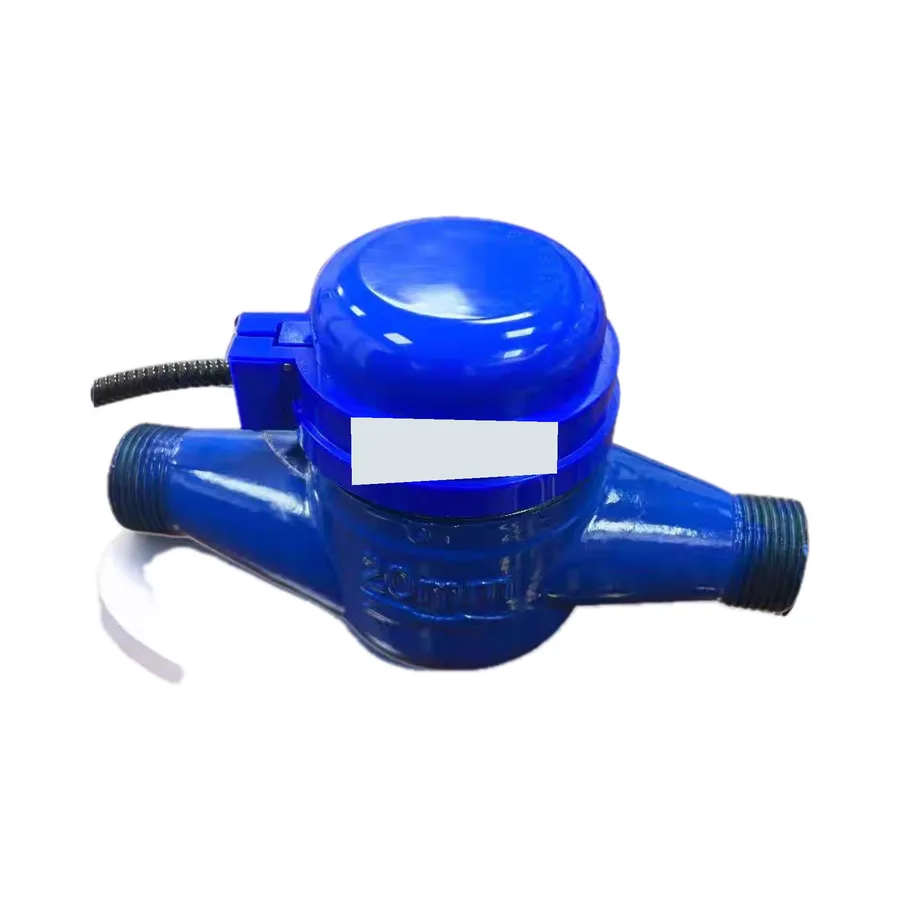
WM-20
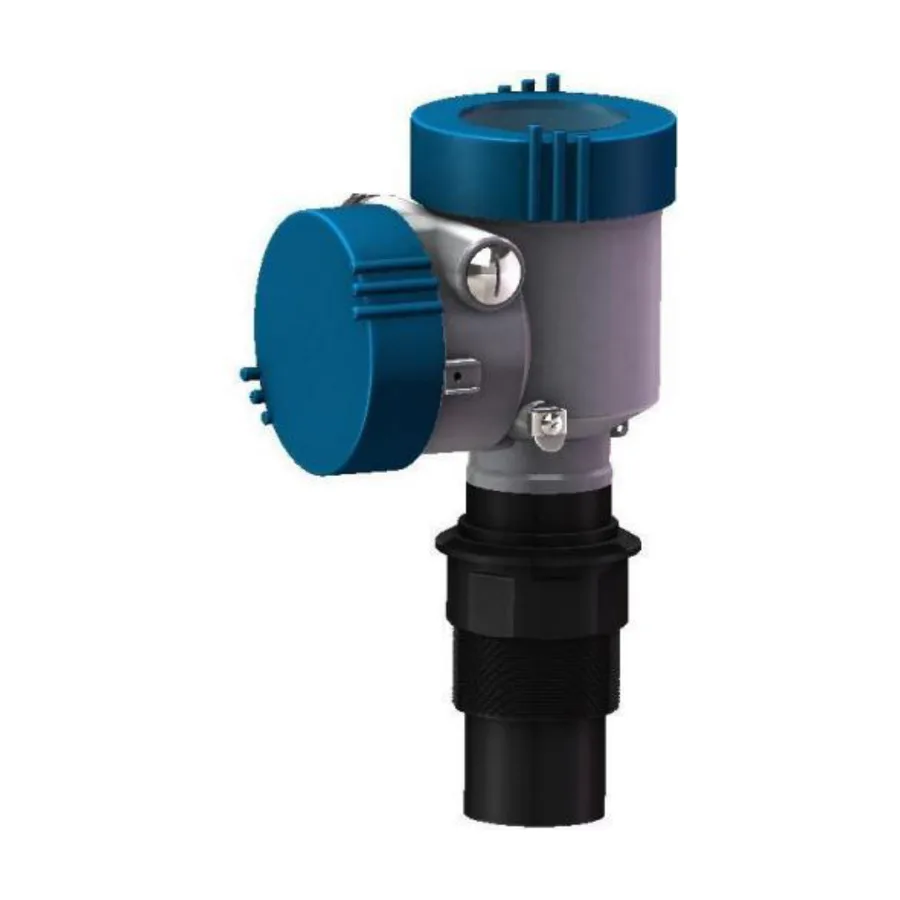
SKU: ULM-100
Non-contact ultrasonic meter for the level in a water tank or reservoir.
The ULM-100 measures how much water stands in a tank. It mounts on top of the tank and looks down at the surface. The probe sends a short ultrasonic pulse, the pulse bounces off the water, and the meter times the echo. From that time it works out the distance to the surface, and from the depth of the tank it works out the level. Nothing hangs in the water and no electronics are wetted, so there is no float to stick and nothing in the tank to scale up or to clean.
The speed of sound in air changes with temperature, and a tank roof in the sun is a very different place at noon and at dawn. The meter carries its own temperature sensor and corrects the measurement automatically. The level is resolved to 3 mm, and accuracy is 0.5% to 1.0% of the measured range.
The transmitter, the probe and an LCD display with a keypad are built into one housing. The level can be read on the display at the tank, and the same reading is available as an electrical signal for recording it elsewhere on the farm. The meter is made for liquids. On a poultry farm that means the water storage tank, the header tank above the houses and an open water reservoir.
Water faults on a poultry farm rarely start at the drinker. They start upstream: a float valve sticks shut, a borehole pump trips, a supply pipe is closed for a repair and nobody opens it again. For some hours nothing looks wrong in the house, because the birds are drinking from what is stored in the tank. The first visible sign is a drinker line that has run dry, and by then the flock has already gone short on a day that may be hot.
The level in the tank shows the fault from its first hour. A tank that is being drawn down and is no longer refilling draws a line that only goes one way. Seen early, the fault is an ordinary repair. The grower still has a tank of water to work with while the valve is freed or the pump is reset.
A healthy tank has a rhythm. The level falls while the birds drink and the supply catches up, then recovers when demand drops at night. Once that pattern is familiar, the departures from it are easy to read.
The record is most useful on farms with their own borehole or with a weak mains supply, where the question in a heat wave is whether the supply can keep up with the birds and the cooling. The level at the end of each hot afternoon answers it with a number, well before the day the tank reaches the bottom.
The ULM-100 can be ordered with one or two relays, each programmable from the keypad. A relay is set as a low alarm or a high alarm with a trigger level and a return difference, the gap the level has to recover before the relay releases. The contacts switch up to 8 A at 250 V AC or 5 A at 30 V DC.
On a farm this gives two practical uses at the tank itself. One relay can drive a siren or a lamp at a low level, so that anyone in the yard knows the tank is running down. The other can start and stop the fill pump. Because the trigger and the return difference are set separately, a single relay runs a complete pump cycle: it starts the pump at one level and stops it at another, without a second float switch in the tank.
The reading is only as good as the path between the probe and the water. Mount the meter so that the probe points straight down, perpendicular to the surface. On a closed tank with a flat top the cleanest way is to fit the meter directly into the top, with no connecting pipe. If a short pipe has to be used, it must be no longer than 60 mm and at least 100 mm in inner diameter, and the face of the probe must come at least 3 cm below the underside of the flange.
Every ultrasonic meter has a blind zone just below the probe where it cannot measure. On the 5 m probe it is 0.3 m. The gap between the probe face and the highest water level has to stay larger than the blind zone, so the meter sits above the overflow level by at least that much.
On an open tank or reservoir the meter goes on a bracket over the water. Keep the 5 m probe at least 0.5 m from the wall and the 10 m probe at least 1.0 m.
The range is fixed by the probe and is chosen when ordering: 5, 10, 15 or 20 m. Measure from the place where the probe face will sit down to the bottom of the tank. That distance, with some margin, is the range you need. Ripples on the surface, mist and a large temperature difference between the probe and the water all weaken the echo, so a tank with a turbulent surface is better served by the next range up.
The longer probes have longer blind zones: 0.4 m on the 10 m probe, 0.6 m on the 15 m and 0.8 m on the 20 m. On a low tank the 5 m probe therefore wastes the least height under the roof. For most farm storage tanks the 5 m or 10 m probe is the one to look at, and the longer ranges are for deep reservoirs and wells.
The other choices follow from the site. The standard supply is 24 VDC, with 220 VAC as an option where that is what the pump house has. The probe is rated IP68 and the display housing IP66, and the probe works from -20 to +80 °C and the display from -20 to +60 °C, so the meter can live on an outdoor tank through summer and winter. Mounting is by thread (G1½, G2, M78×2, NPT 1½ or NPT 2) or by flange from DN50 to DN100. The standard probe is a polymer, and PVDF or PTFE probes are available for tanks that hold something more aggressive than water.
Setting up takes a few minutes at the keypad. The meter is told the distance from the probe face to the bottom of the tank, and from then on it shows the level of the water above the bottom. It can also be set to show the distance from the probe to the surface, the empty height above the water.
The meter has three response speeds. The slow setting ignores short disturbances and suits a tank with a splashing inlet. The fast setting follows the level closely and suits a small header tank that empties quickly. The medium setting is the factory default and is right for most storage tanks. If the echo is lost for a moment, because of foam or a wave under the probe, the meter holds the last good value until the echo returns.
A reading that freezes or jumps nearly always comes from the installation. Check that the probe still points straight down, that nothing has been fitted inside the tank under the beam, and that the water has not risen into the blind zone. Erratic readings near a pump with a variable speed drive are an earthing and cable routing matter, and separating the signal cable from the motor cable usually settles them.
Mount the meter above the tank, perpendicular to the water surface, with the gap between the probe face and the highest water level larger than the blind zone (0.3 m on the 5 m probe). Keep it clear of the fill stream and of pipes inside the tank, which return false echoes. It connects to the Genesis controller over RS485 and runs on 24 VDC.
The range is chosen with the probe: 5, 10, 15 or 20 m. The 5 m probe has a 0.3 m blind zone and the 10 m probe 0.4 m.
It has an LCD with a keypad, a 4-20 mA output and up to two optional programmable relays for a level alarm on site. Connected to a Genesis controller over RS485, it adds phone alerts and stored history.
The probe is rated IP68 and the display housing IP66. The probe works from -20 to +80 °C and the display from -20 to +60 °C.
WM-20
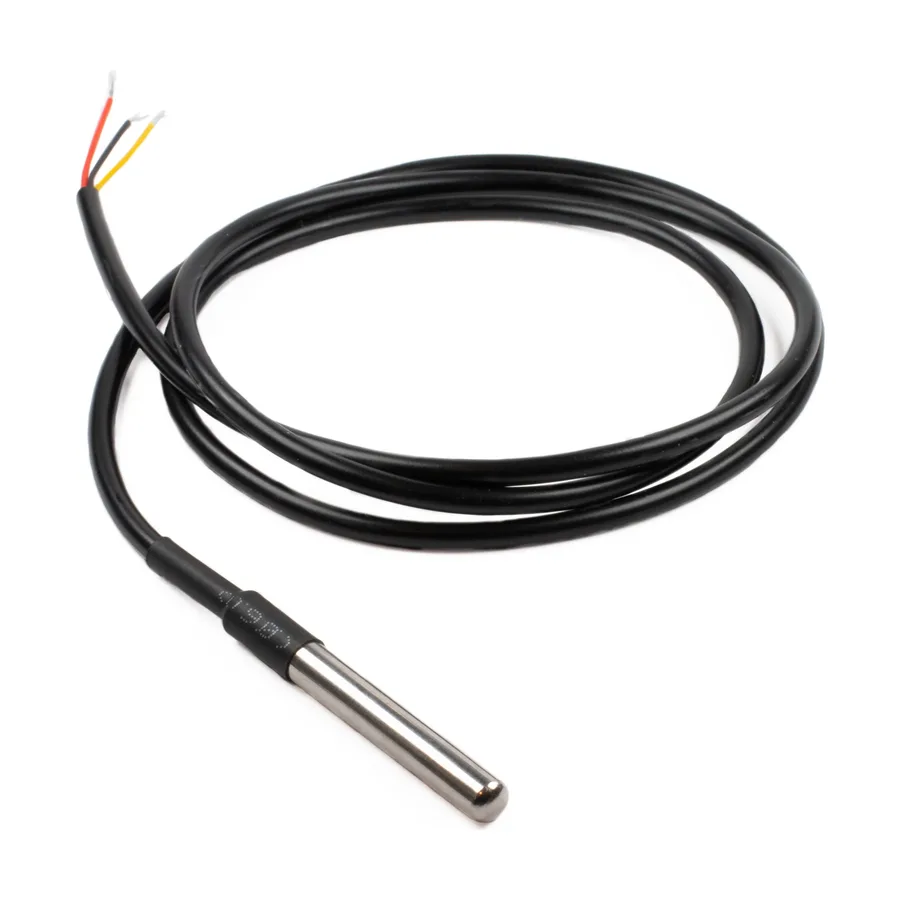
DS18B20
Send the number of houses, the birds and what you want to watch. You get a proposed set of sensors per house and a quote, with the datasheets.