Hatching egg storage temperature and humidity
Hatching egg storage temperature and humidity by days in store, from the Cobb, Aviagen and Hy-Line guides, with turning, sweating and pre-warming.
Hatchery and eggs 9 min read
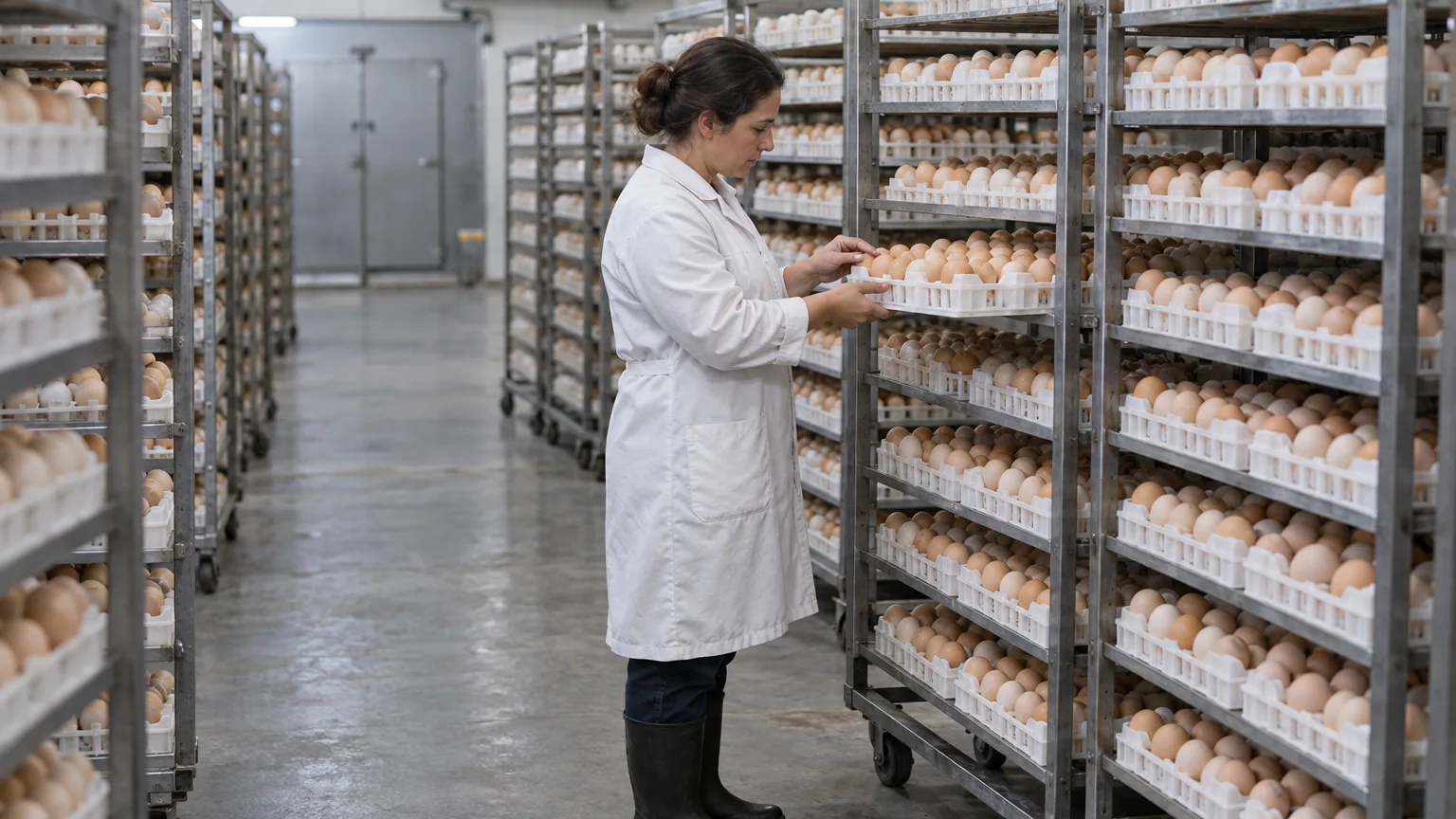
A hatching egg has to get through storage with its embryo paused, and that depends above all on the temperature of the egg store. The breeding companies’ guides agree that the longer an egg will wait, the colder the store should be. Aviagen’s latest guidance goes further and recommends one value, 15 °C, for eggs of every age.
Temperature and humidity by days in store
The Cobb Hatchery Management Guide (2020) gives this table:
| Days in store | Temperature | Relative humidity |
|---|---|---|
| 1 to 6 | 18-19 °C | 50-60% |
| 7 to 10 | 16-17 °C | 50-60% |
| 11 or more | 15-16 °C | 60-70% |
Cobb adds three points. Humidity matters less than temperature. In long storage the humidity goes up so the egg does not lose too much water, but always stays below 80%, because high humidity helps fungi grow and spread. And to limit the damage of long storage it advises lowering the temperature, but not below 15 °C.
Aviagen’s Hatchery Tips 2025 simplifies the table to one setting: hold the egg store at 15 °C for all egg ages. The same document summarises two studies behind the change:
- In a trial with Ankara University, using eggs from young, prime and old flocks stored for 14 days, eggs stored at 18 °C hatched 4.4% worse on average than eggs stored at 15 °C, over four comparisons. Eggs stored at 12 °C hatched no better than those at 15 °C.
- Measured by embryo stage, eggs held at 18 °C advanced by 7.35% over 14 days, enough to affect hatchability. At 15 °C the embryo barely moved from its stage at lay, by 1% at most.
Aviagen’s conclusion is that unless eggs are set very fresh (no more than 4 days old), the store is better run at 15 °C than at 18 °C. Fresh eggs hatch just as well when stored colder; it is the older eggs that suffer in a warm store. The one thing to watch is condensation when cold eggs move into the setter rooms, covered below.
Layer strains. Hy-Line’s SPIDES Technical Update (2017) asks for eggs to be in cool storage within 6 hours of laying, stored at 15-18 °C and 70-80% relative humidity, and moved to 13 °C at the same humidity, or to a SPIDES programme, if they must wait more than 10 days. Hy-Line’s best hatches come from eggs 3 to 7 days old.
Humidity: enough for the egg, too little for fungi
An egg loses water through its shell throughout storage. Aviagen puts the loss at about 0.5% of the egg’s weight after a week in reasonable conditions, which does not seem to harm hatch or chick quality. The rate depends on the difference in water vapour between the inside of the egg and the air of the store, and in Aviagen’s calculation, lowering the store from 18 to 15 °C slows the loss as much as raising humidity by five points, without adding to the risk of contamination.
Most bacteria and fungi need a relative humidity of 60% or more. Aviagen therefore recommends 50-60% as the balance between the egg’s water loss and hygiene in the store, and advises against humidifiers except in very dry climates, because standing water reservoirs encourage bacterial growth. Cobb gives the same warning: humidifiers collect dirt and water where bacteria and moulds grow. If humidity goes above 90%, Aviagen’s ventilation checklist says to ventilate to bring it down.
In tropical areas, or in summer in temperate ones, a dehumidifier is needed. The air leaving it can be 3-6 °C warmer than the room set point, so Aviagen recommends placing it away from the egg racks, next to the air conditioner and higher than the eggs.
The guides agree on humidity less than on temperature: Hy-Line asks for 70-80% for its layer strains. Use the value in your own breed’s guide and record it with the temperature.
How long an egg can wait
According to Cobb, hatchability is best for eggs stored 3 to 6 days. Setting within 48 hours of lay costs 1-2% of hatch, because the albumen has not yet reached its best pH. From day 6 the losses run at 0.5% a day up to day 10, and 1.0-1.5% a day after that. The effect is stronger in eggs from breeder flocks over 55 weeks old, which have thinner shells and albumen that degrades faster.
Stored eggs also take longer to hatch. Cobb adds the time at the start of incubation, which means setting earlier:
| Egg age at setting | Incubation time |
|---|---|
| 7 days or less | No change |
| 8 to 9 days | 1 hour longer |
| 10 to 11 days | 2 hours longer |
| 12 days or more | 3 hours longer |
When long storage cannot be avoided, both breeding companies describe SPIDES, short periods of incubation during egg storage. For the egg store, the critical moment is when those eggs come back. Cobb asks for them to be returned only once they are within 2 °C of storage temperature, and placed where they will not warm other eggs. Aviagen shows with thermal images how eggs put back at 24 °C warmed the trolleys beside them to a point where embryo development carries on.
Turning eggs in storage
If eggs will be stored for more than seven days, Aviagen recommends turning them 4 to 6 times a day where possible. Cobb gives the reason: after 8 days or more the albumen breaks down and the embryo can drift close to the shell, leading to early embryo mortality from dehydration. The other option Cobb gives is to store eggs small end up and turn them back large end up before incubation.
Sweating: why eggs get wet
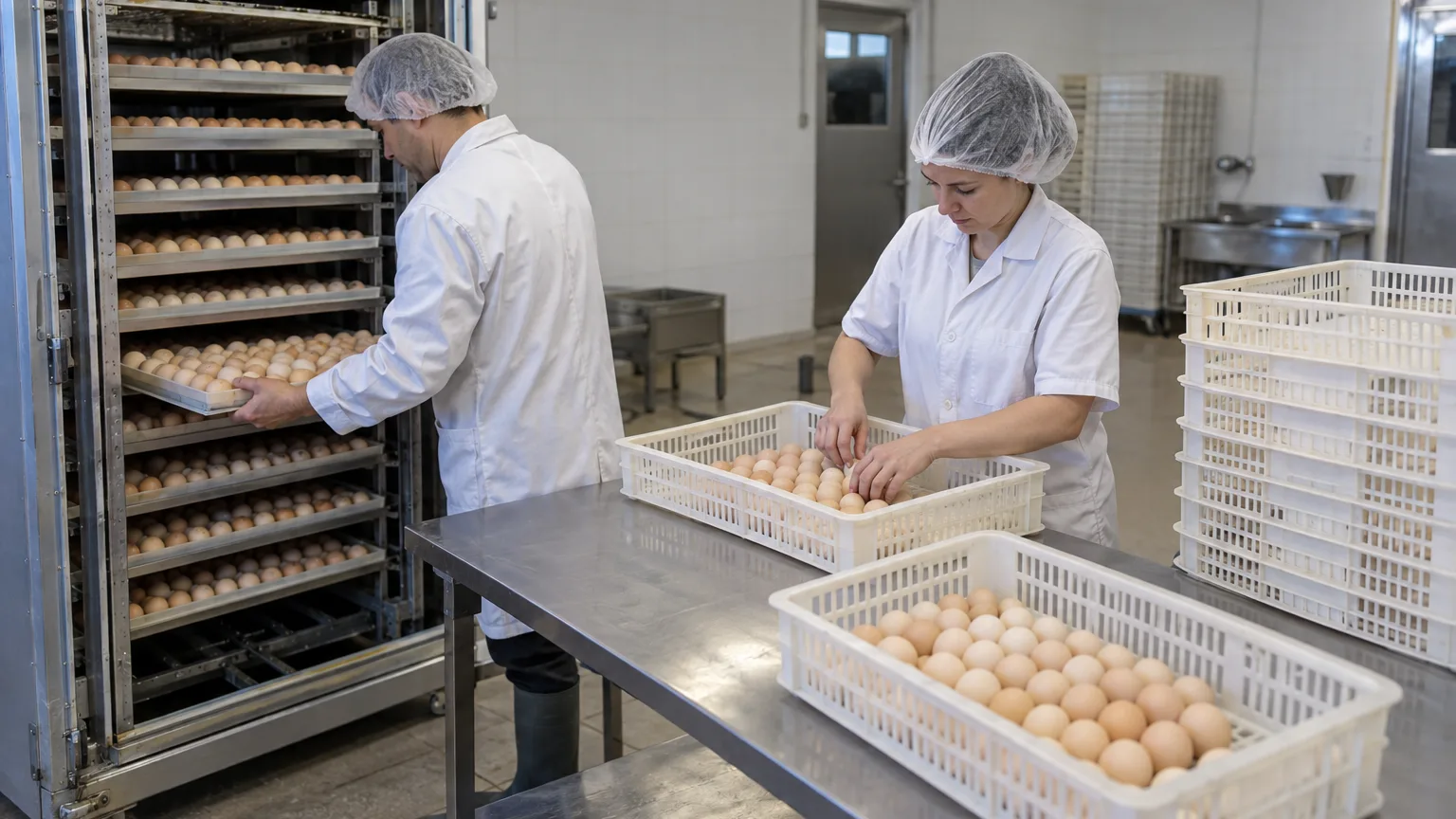
Cobb names three places where eggs are stored: the farm egg room, the transport and the hatchery egg room. Conditions in all three should match, because a sharp change in temperature and humidity makes eggs sweat. Water on the shell gives bacteria and mould spores a place to stick and the water they need, and inside a warm, moist setter the contamination spreads to other eggs, embryos and chicks. To find out whether eggs sweated on the way, Cobb suggests the crepe paper test: wrap one egg in crepe paper at the farm and check it for dye stains at the hatchery.
An egg sweats when its shell is colder than the dew point of the air around it. Aviagen’s Investigating Hatchery Practice (October 2009) gives the table. Each cell is the shell temperature below which an egg gets wet:
| Room air | 50% RH | 60% RH | 70% RH | 80% RH |
|---|---|---|---|---|
| 23 °C | 12 °C | 15 °C | 17 °C | 19 °C |
| 25 °C | 13 °C | 16 °C | 19 °C | 21 °C |
| 30 °C | 18 °C | 21 °C | 24 °C | 26 °C |
An egg leaving a 15 °C store for a room at 25 °C and 60% humidity sweats, because the dew point of that air is 16 °C. The same egg in a room at 23 °C and 50% does not. The same guide warns that eggs stored at 12 °C are liable to sweat unless they spend a short time at an intermediate temperature before pre-warming, and that a sweating egg is not fumigated or put back in a cold store until it is dry. After storage at 15 °C, Aviagen’s 2025 tips consider condensation unlikely within the hatchery, though still worth checking against the table.
When eggs arrive from the farm, Aviagen’s 2025 checklist asks you to:
- check eggshell temperature on arrival, aiming for no more than 1-2 °C above the hatchery egg store;
- check for condensation, and use extra fans to dry eggs quickly where needed;
- let eggs rest in the store for 24-48 hours after transport;
- never put warm eggs next to cold ones, or warm trolleys next to cool ones.
Pre-warming before set
According to Cobb, pre-warming reduces the shock to the embryo, prevents condensation and evens out egg temperatures at setting, which narrows the hatch window.
- Single-stage setters. Pre-warming happens inside the machine, typically 6 hours at 26.6 °C, and those hours are not added to the incubation time.
- Multi-stage setters. Eggs are pre-warmed in a purpose-built room or chamber at about 24-27 °C. With good air circulation, a trolley of eggs takes 6 hours to reach 26 °C whatever its starting temperature; with poor circulation it can take twice as long, and uneven pre-warming widens the hatch window.
For multi-stage machines, Aviagen’s 2025 tips ask for the pre-warming room to reach its set point within 6-8 hours, with all eggs at an even temperature before loading. The right temperature is the one at which the setter drops no more than 1 °C when the new eggs go in and recovers within 40 minutes, typically between 29.4 and 32.2 °C. Setting cold eggs has a cost: when eggshell temperature falls below 37.2 °C, the hatch is delayed and early embryo mortality goes up.
The exact value comes from your breed’s guide and the setter manufacturer. What the two guides share is the time, 6 to 8 hours, and air moving through the eggs.
What to measure in the egg store
Cobb asks for eggs to be stored in a dedicated room where temperature and humidity are controlled, monitored and recorded, for the temperature to be checked in different parts of the room, and for data loggers to be considered in each area. For the farm egg room, the Cobb Breeder Management Guide (2020) asks for the maximum and minimum temperature and the humidity to be recorded every day, three times a day at the same times.
Averages are not enough. In one of Aviagen’s examples, a setter room log had a sound average, yet the room ran warm for several hours each day because doors were left open. In the egg store, swings cost hatch: when storage temperature moves from 18 to 21 °C three times a day, hatchability suffers.
In practice that means:
- temperature and humidity at egg height, at more than one point in a large store;
- a high limit close to the working temperature, because the damage comes from rises that the average hides;
- confirmation that the cooling unit is running;
- the store temperature against the dew point of the room the eggs go to next.
Henlytics keeps that record continuously, with a temperature and humidity probe among the trolleys, a current sensor on the cooling unit and phone alerts that repeat until someone acknowledges them. Climate inside the setters and hatchers, and in the rooms around them, is covered in incubator temperature, humidity and CO2.