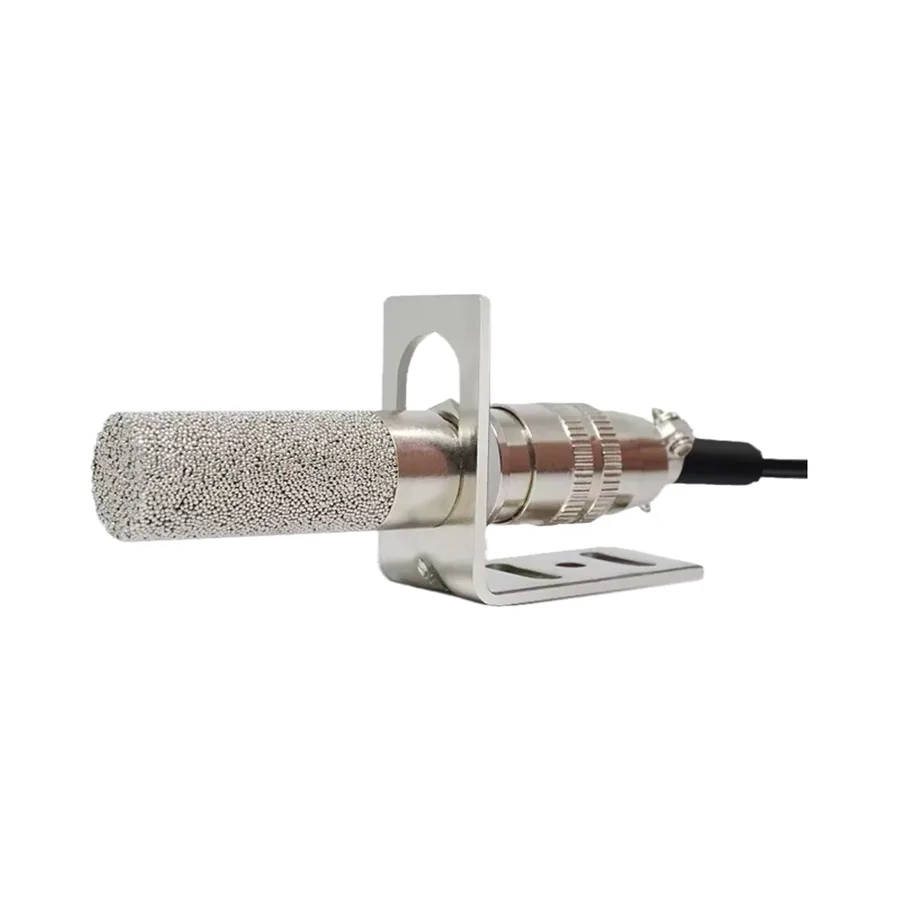
THS-100 temperature and humidity sensor for poultry houses
SKU: THS-100
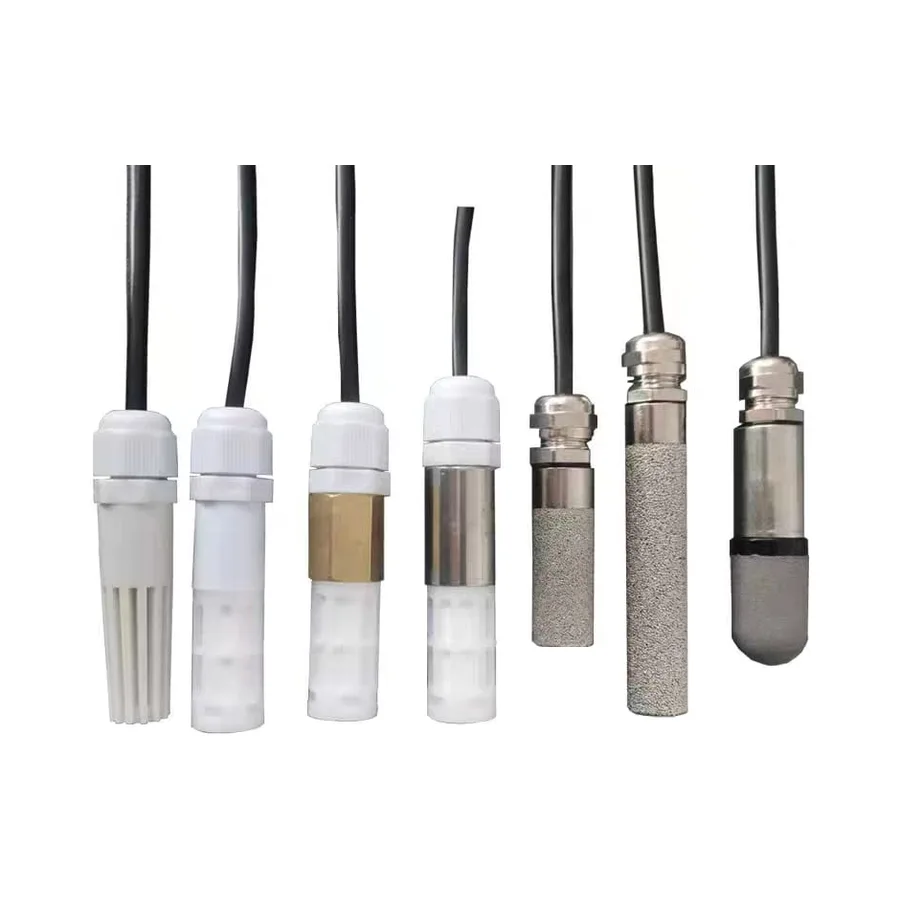
Digital temperature and humidity probe in seven housings for dust, humidity and wash-down.
- Temperature
- -40 to +80 °C, ±0.3 °C (at 25 °C)
- Humidity
- 0-100% RH (non-condensing), ±3% RH (at 60% RH, 25 °C)
- Output
- RS485 Modbus-RTU
One temperature and humidity sensor for every room on a poultry farm
The THS-100 is a digital temperature and humidity sensor. The measuring element and its electronics sit inside a slim probe, between 57 and 87 mm long depending on the housing, on a 4-wire cable that comes 1 m long as standard. It measures air temperature from -40 to +80 °C and relative humidity from 0 to 100%, and it takes a fresh measurement every 2 seconds.
A poultry farm has several very different climates under one roof. The bird area is warm and full of dust. The air behind the cooling pad is close to saturated. The egg room is cool, clean and dry. The THS-100 answers this with seven probe housings around the same electronics, so one model with one set of specifications can be fitted at every one of these points and the readings can be compared with each other.
How accurate is the THS-100 on temperature and humidity?
Temperature accuracy is ±0.3 °C at 25 °C, and humidity accuracy is ±3% RH at 60% RH and 25 °C. Both values are shown with a resolution of 0.1, which is fine enough to see a house drifting by a few tenths of a degree over an afternoon, long before the birds show it.
Stability matters as much as the accuracy on day one, because a house sensor stays in place for years. The THS-100 drifts by no more than 0.1 °C and 1% RH per year. With the vented cap it follows a change in temperature within 15 seconds and a change in humidity within 4 seconds in moving air of 1 m/s, so the opening of an inlet or the start of a heater is visible as it happens.
The probe also accepts a temperature offset and a humidity offset. If a check against a reference thermometer shows a small difference, the probe is trimmed to the reference and stays in service.
Choosing the probe housing for the bird area, the egg room and the cooling pad
All seven housings measure the same way. What changes is how the element is protected, and that decides where each one belongs. An open cap lets the air reach the element fastest. A sealed or sintered housing keeps dust and water away from it and answers a sudden change in humidity more gradually.
- Vented PVC cap: dry indoor air such as the egg room or a service room. It has the fastest response and it is not waterproof.
- Sintered metal filter, in a 57 mm and an 87 mm length: the dusty bird area. The short version responds faster.
- Sealed polymer, brass or stainless steel body: places with high humidity, fog or rain, such as the air behind the cooling pad or a point outside the house.
- IP67 sintered housing: areas that are washed down.
Brooding temperature and humidity at chick placement
A day-old chick cannot hold its own body temperature, so for the first days the house does it for the chick. Brooding targets are set by bird age and fall step by step as the flock feathers. The figures for your birds are in the breed management guide, and the THS-100 reads to 0.1 °C against them.
Humidity belongs in the same picture. Heaters dry the air in an empty, preheated house, and chicks that arrive from a humid hatcher into very dry air lose water quickly. A probe that gives both values from the same point shows whether the house is ready before the truck arrives, and whether it stays within the guide through the first nights, when nobody is standing in the house to feel it.
In the brooding area a sintered filter housing is the usual choice, because chick down, litter dust and feed dust start on the first day.
Checking evaporative cooling pad performance with two probes
An evaporative pad cools the incoming air by evaporating water into it. The air leaves the pad cooler and more humid than it entered. How many degrees the pad takes off depends on how dry the outside air is and on the state of the pad itself: an evenly wet, clean pad cools well, and a pad with dry streaks or scale lets warm air through.
One THS-100 in the outside air before the pad and one in the air stream after it show the temperature drop across the pad through the whole day. A drop that shrinks on a day when the outside air is just as dry as it was the day before points to the pad, the pump or the water distribution. For the outside probe, the datasheet calls for a radiation shield, so that the sun does not heat the probe above the air temperature.
The humidity reading after the pad is as useful as the temperature. On a humid afternoon the pad adds moisture and removes very little heat, and the grower can see from the two probes when running the pump has stopped helping the birds.
Egg room and hatchery temperature and humidity
Table eggs and hatching eggs are both held in a cool room between collection and transport, and both lose quality when the room warms up or dries out. On a breeder farm the store is the first link in incubation, and the hatchery sets the storage conditions it wants from its supply farms. In a hatchery the same measurement is needed in the egg store, the setter and hatcher halls and the chick holding room.
These rooms are clean and dry, so the vented PVC cap is the right housing. It gives the fastest response and shows what happens when a door is left open during loading or when a cooling unit stops at night. A second probe near the door, compared with one at the back of the room, shows whether the whole stack of trays sits at the same temperature.
Where to mount the sensor and how to keep it reading right
Mount the probe where air moves freely around it and where it sees the air the birds or the eggs are in. Keep it away from direct sunlight, from heaters and from vents and inlets, because each of these gives a reading of the heat source or the incoming air and not of the room. Where the vented PVC cap is used, avoid points where water condenses on the probe.
Maintenance is short. Keep the filter cap clean and unblocked, since a cap coated with dust slows the response and holds moisture against the element. Compare the readings with a reference instrument from time to time, at clean-out between flocks for example, and use the offset when the two differ.
THS-100 or THS-200, and how many sensors per house
The THS-100 is the model to choose when the farm has different kinds of rooms, when a stated accuracy is needed, as in an egg store or a hatchery hall, or when a fast open probe is wanted in clean air. The THS-200 comes in one build, with a sintered stainless steel filter, a mounting bracket and a screw-lock connector, and it is made for the dusty and wet bird area. A farm can use both: THS-200 probes over the birds and THS-100 probes in the egg room and on each side of the cooling pad.
The number of sensors follows the number of climate zones. A short house may be covered by one probe in the bird area. A long tunnel house is warmer at the fan end than at the inlet end, so a probe near each end shows the difference the birds live with. Add one before and one after the cooling pad, and one in each egg room. Send us the house dimensions and the ventilation type, and we will mark the positions and the housing for each one.
- Measures
- Air temperature and relative humidity
- Temperature
- -40 to +80 °C, ±0.3 °C (at 25 °C)
- Humidity
- 0-100% RH (non-condensing), ±3% RH (at 60% RH, 25 °C)
- Resolution
- 0.1 °C, 0.1% RH
- Response time
- ≤15 s temperature, ≤4 s humidity (1 m/s airflow)
- Stability
- ≤0.1 °C/year, ≤1% RH/year
- Output
- RS485 Modbus-RTU
- Supply
- 5-28 V DC
- Power
- ≤0.05 W
- Cable
- 4-wire, 1 m standard
- Material
- Seven probe housings: vented PVC cap, sealed polymer, brass, stainless steel, sintered metal filter (two lengths), IP67 sintered housing
- Dimensions
- Ø12.5-16.5 × 57-87 mm, by housing
Where it goes
Choose the housing for the location: sintered metal filter for dusty areas, IP67 sintered housing for wash-down, vented PVC cap for dry indoor air. Mount the probe away from direct sunlight, heaters and vents, with free air circulation around it, and keep the filter cap clean. It connects to the Genesis controller on a 4-wire cable and runs on 5-28 V DC.
What the reading does in Henlytics
- A phone alert when temperature or humidity leaves your range, repeated until acknowledged
- Temperature and humidity history for every house, charted with ammonia and CO2
- Excel export per house and period
Which THS-100 housing suits a poultry house?
Use a sintered metal filter housing in the dusty bird area and the IP67 sintered housing where the house is washed down. The vented PVC cap responds fastest and suits dry indoor rooms such as egg storage.
How accurate is the THS-100?
Temperature accuracy is ±0.3 °C at 25 °C and humidity accuracy is ±3% RH at 60% RH and 25 °C. Long-term stability is ≤0.1 °C and ≤1% RH per year, and an offset can be written to trim a probe against a reference.
How far can the probe be from the controller?
The probe ships with a 1 m, 4-wire cable, and the RS485 bus can run up to 2000 m with proper cabling and termination. Several probes share one bus, each on its own address.
In the same group
All products-
- NH3
GF-201-NH3
Ammonia detector
-
NH3-210
Compact ammonia sensor
- CO2
GF-201-CO2
CO2 detector
Tell us the houses, we will pick the sensors
Send the number of houses, the birds and what you want to watch. You get a proposed set of sensors per house and a quote, with the datasheets.